Since 1985, this humble Singapore establishment has been making the little red tortoise cakes that carry centuries of Chinese tradition, one piece at a time.
A Little Red Tortoise With a Big Meaning
Some foods satisfy our appetites. Others carry meanings far beyond their ingredients, and the humble Ang Ku Kuih (紅龜粿) belongs firmly in the latter category. Its name comes from Hokkien: ang means red, ku means tortoise, and kuih refers to a traditional cake or pastry. Originating from Fujian province in China, the tradition likely travelled to Southeast Asia with early Chinese migrants who settled in Nanyang.
The tortoise symbolises longevity, while red represents happiness and good fortune. Together, they form an edible blessing that has graced Chinese celebrations for generations, from newborns’ first-month celebrations to birthdays, religious offerings and traditional festivals.
Forty Years of Tradition, Many Pairs of Hands
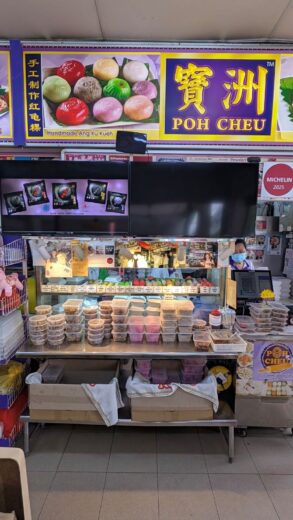
We arrived on a weekday afternoon to find a steady queue, thankfully nothing like the snaking lines reportedly seen on weekends. But what caught our attention wasn’t the queue or even the colourful display of kuih. It was the fascinating scene unfolding behind the counter.
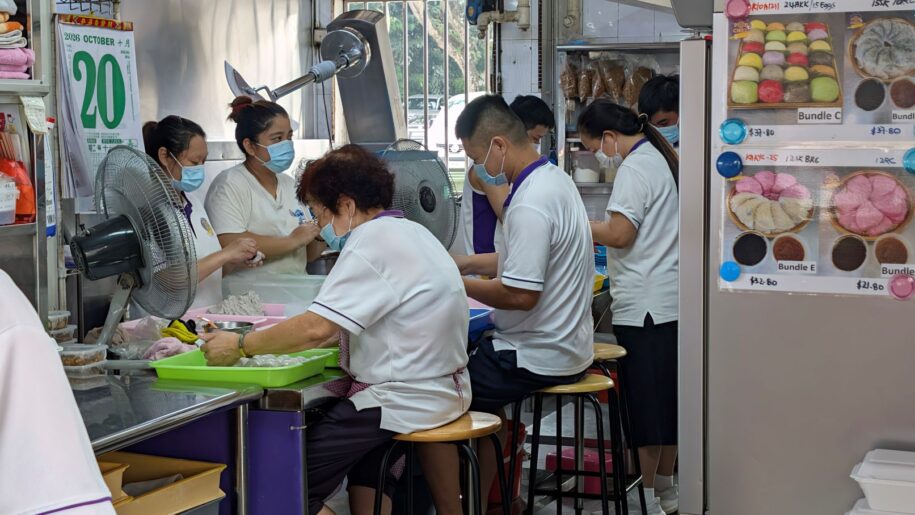
Seated along a production line was a team diligently kneading, filling and shaping Ang Ku Kuih. Elderly ladies whose practised movements suggested years of experience worked alongside younger colleagues. Each had a clearly defined task, with pieces of dough passing from one pair of hands to another in an almost rhythmic sequence.
There was something captivating about watching this human assembly line. Every movement involved judgement and skill, repeated with remarkable consistency. It was an artisanal performance without any intention of being one. Nobody was putting on a demonstration; these people were simply getting on with their work, producing hundreds of little dessert that customers would finish in a few bites.
The Delicate Art of Getting the Skin Right
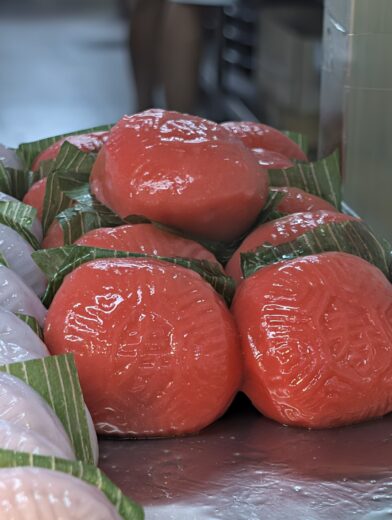
At Poh Cheu, the skin was particularly well executed. It yielded softly with each bite, offering enough resistance to be satisfying without sticking to our teeth. Even the auspicious Chinese characters embossed into the surface remained reasonably distinct.
One challenge in making Ang Ku Kuih is maintaining its softness after cooling. Some versions become stiff or tough, often due to imbalances in the flour mixture, moisture, oil or steaming process. Poh Cheu passed this test convincingly. Even after sitting for approximately two hours, our Ang Ku Kuih remained pleasantly soft and pliable.
Thirteen Flavours, But We Went Back to the Classics
Poh Cheu offers up to 13 flavours, including mango, green tea, durian and black sesame. However, true to The Humble Belly’s fondness for old-school flavours, we chose the classics: peanut and mung bean.
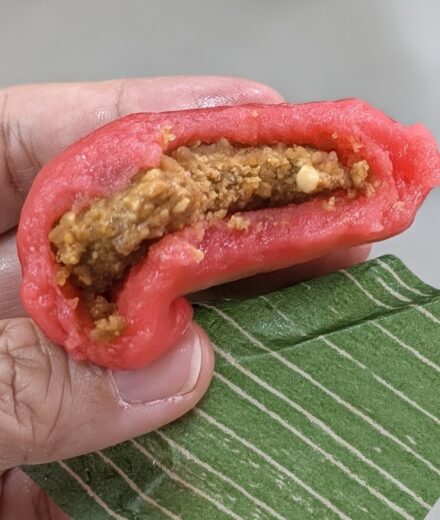
The peanut Ang Ku Kuih was easily our favourite, and apparently we weren’t alone, as it is also the shop’s most popular flavour. The freshly toasted peanuts delivered a lovely nutty fragrance with every bite, while their slightly granular texture contrasted beautifully with the smooth, chewy skin. Just as importantly, the sweetness was restrained, allowing the natural roasted peanut flavour to shine.
The mung bean version, however, was less successful in our opinion. Although the skin maintained its pleasant softness, the filling was comparatively less generous and lacked the depth of flavour we have enjoyed elsewhere.
We have also encountered Ang Ku Kuih with more generous filling-to-skin ratios. Does that necessarily make Poh Cheu’s version inferior? Not quite. Because its skin remains tender rather than thick and dense, the kuih doesn’t feel excessively doughy or burdensome to eat. After all, good Ang Ku Kuih isn’t simply a competition to see who can squeeze the most filling into the thinnest skin.
Traditionally, Ang Ku Kuih is steamed on individual pieces of banana leaf, which serve not only as a natural base but also impart a delicate fragrance to the kuih. At Poh Cheu, however, these have been replaced with sheets printed to resemble banana leaves. We felt this was a shame. While it may seem like an insignificant change, the gentle aroma imparted by real banana leaves is part of the traditional sensory experience. It is a small detail, but one that reminds us how preserving heritage food goes beyond recipes and techniques. Sometimes, even the humble banana leaf has a role to play in the final flavour.
A Little Piece of Heritage Worth Keeping
What makes Poh Cheu interesting isn’t merely its assortment of flavours, but its continued reliance on handmade craftsmanship. Watching experienced workers alongside younger colleagues was encouraging, because traditional food knowledge survives through practice, not simply written recipes. The pressure needed to shape a kuih, the judgement required to achieve the right dough consistency and the ability to maintain quality throughout a busy day are skills that take time to master.
Besides Ang Ku Kuih, Poh Cheu offers other traditional treats, including abacus seeds, cai kuih and soon kuih. Those will have to wait for another visit. For now, we will settle for its peanut Ang Ku Kuih.