
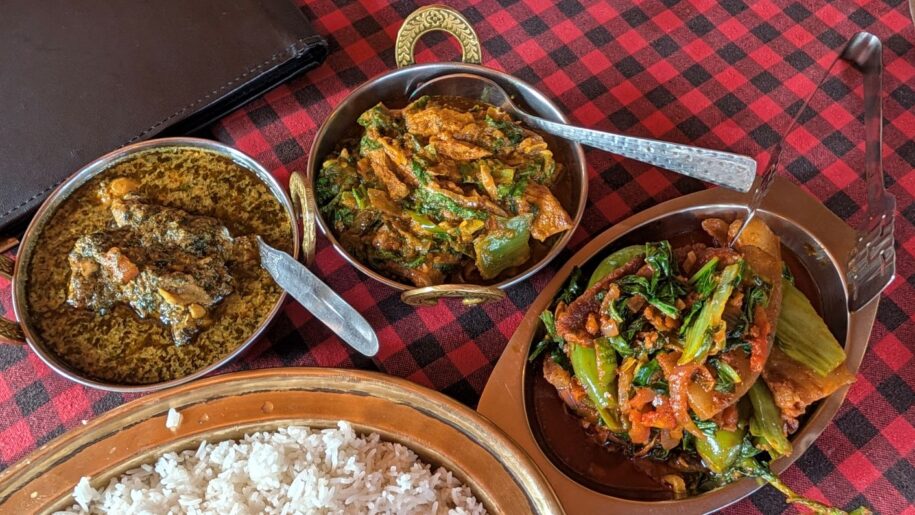
A Little Restaurant with a Big Reputation
There is something rather humbling about visiting a country whose cuisine you know very little about. You can read all the travel guides, memorise the names of traditional dishes and watch countless food videos, but nothing quite prepares you for the experience of actually sitting down and tasting the food.
After several days travelling through the beautiful Kingdom of Bhutan, we realised that despite enjoying various cuisines along the way, we had barely scratched the surface of Bhutanese cooking. With just a few hours remaining before our flight out of Paro, we decided it was time to remedy that.
Our destination was Sonam Trophel Restaurant, a modest family-run establishment that has been serving Bhutanese cuisine since 1993. To put that into perspective, the restaurant was already feeding customers six years before Bhutan introduced television and internet services in 1999. It belongs to a generation when dining was less about online reviews and more about good food and word of mouth.
Widely recommended and considered by some to be among the best restaurants in Paro, Sonam Trophel was certainly not short of customers. The quaint little restaurant seats approximately 50 diners, and we were fortunate to secure the last available table that afternoon. Every other table was booked.
Understanding Bhutanese Food Before Judging It
Bhutanese cuisine is shaped by its geography, mountainous climate and centuries of cultural exchange with neighbouring Tibet, India and the wider Himalayan region. High-altitude crops, preserved meats, dairy products and chillies form the backbone of many traditional dishes.
Unlike much of Southeast Asia, where chillies are generally used to provide heat, Bhutanese cooking treats them almost like vegetables. Cheese is another essential ingredient, often paired with chillies to create hearty dishes suited to the cold Himalayan climate. Meat preservation through drying and curing has also traditionally been important, particularly when fresh supplies were difficult to obtain during harsh winters.
We should make a confession here. Our knowledge of Bhutanese cuisine is nowhere near extensive enough for us to confidently judge whether a particular dish represents the finest or most authentic rendition of its kind. It would hardly be fair to march into a Bhutanese kitchen armed with a Southeast Asian palate and start declaring what the food ought to taste like.
Instead, we approached this meal with curiosity and an open mind. Our intention was to understand the dishes, appreciate the ingredients and cooking traditions, and share what we experienced. And while we may not be qualified to award marks for Bhutanese culinary authenticity, we are certainly qualified to recognise when something tastes bloody good.
Ema Datshi with Chicken – Bhutan’s National Comfort Food
If there is one dish synonymous with Bhutanese cuisine, it is Ema Datshi, the country’s much-loved combination of chillies and cheese. Ema means chilli and datshi refers to cheese, two ingredients that Bhutanese cooks have transformed into something of a national obsession.
At Sonam Trophel, we ordered a version with chicken, generously simmered in a melted cheese sauce with green chillies. Knowing that our spice tolerance might not quite match the Bhutanese appetite for heat, the restaurant kindly offered to tone down the chilli level.
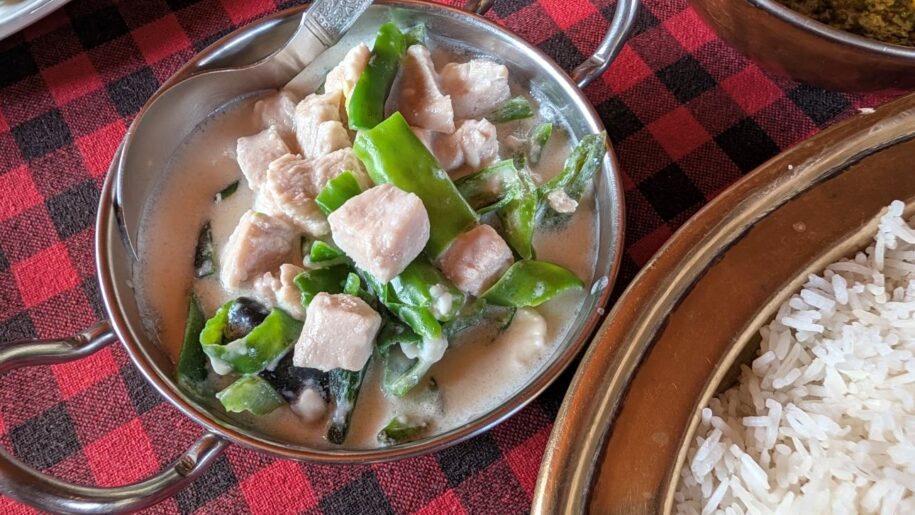
The result was a wonderfully comforting dish. The cheese sauce was thin, creamy and savoury, coating the tender chicken pieces while the green chillies contributed their distinctive vegetal flavour. Compared with other versions we had sampled during our travels, this was considerably gentler on the tongue, but it certainly wasn’t lacking in flavour.
There was something particularly appealing about its simplicity. No elaborate spice blends or complicated presentation, just a handful of ingredients brought together to create a dish that felt entirely at home in the mountains of Bhutan.
Sikam Paa – The Dried Pork That Stole the Show
Of everything we ate that afternoon, Sikam Paa was the undisputed crowd favourite.
Sikam refers to dried pork, traditionally prepared by hanging strips of fatty pork belly to dry, a preservation technique born out of necessity in Bhutan’s mountainous environment. Depending on the preparation, the meat may also develop smoky notes through exposure to wood fires.
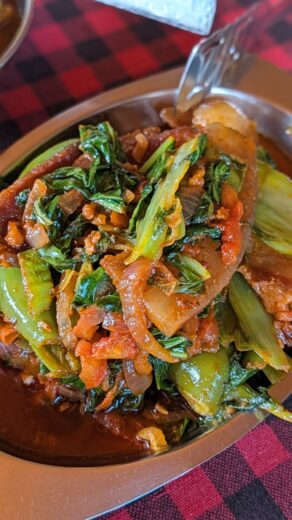
What arrived at our table was quite a revelation. The pork had a relatively high proportion of fat, made more apparent by the dehydration of the lean meat. Ordinarily, that might suggest something overwhelmingly greasy, but the eating experience was quite the opposite.
The meat was intensely savoury, with an earthy depth and a mild chilli warmth. The fat was rich without being unpleasantly oily, its texture resembling a soft jelly, while the softened meat retained a satisfying chew that encouraged you to slow down and savour each bite. The mustard greens brought a welcome contrast, cutting through the richness beautifully.
It was one of those dishes where everyone at the table kept reaching for another piece, even after declaring themselves quite full. If there was one dish that would bring us back to Sonam Trophel, this would be it.
Chicken Methi Ko Sag – Familiar Ingredients, Unexpected Flavours
Given Bhutan’s proximity to India, it is hardly surprising to encounter ingredients and culinary influences shared between the two countries. But sharing ingredients does not necessarily mean sharing the same flavour profile.
Chicken Methi Ko Sag, prepared with fenugreek leaves, was a particularly interesting example.
Fenugreek is widely used in Indian cooking, where its earthy, slightly bitter character frequently accompanies aromatic spice blends and rich gravies. Sonam Trophel’s interpretation, however, tasted distinctly different from Indian preparations. Tender pieces of chicken were simmered with fenugreek leaves in a light, savoury gravy built around ingredients such as mustard oil, ginger, garlic and tomatoes. Rather than allowing spices to dominate, the dish brought forward the gentle bitterness and earthy fragrance of the greens.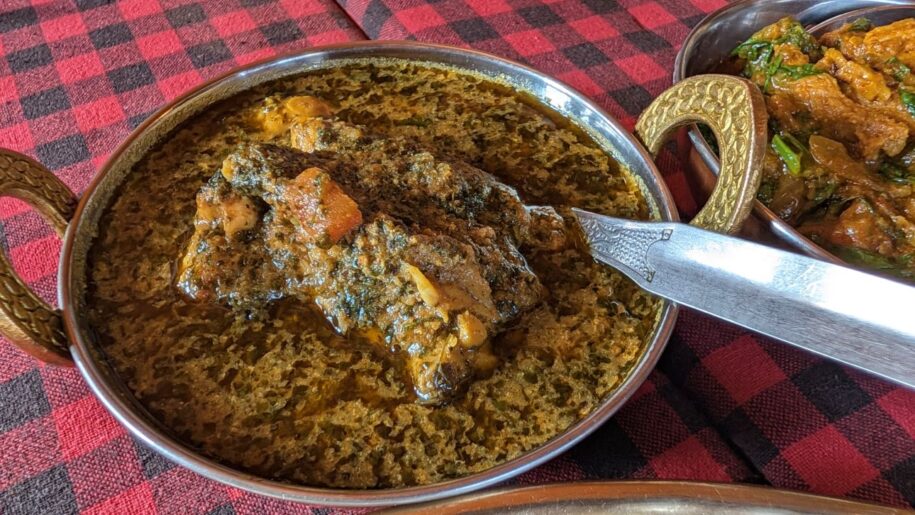
What we particularly enjoyed was its restraint. There was none of the heavy richness we might associate with certain Indian curries. Instead, the gravy had a comforting, homely quality that made it remarkably approachable, even though the flavour combination was relatively unfamiliar to us. It was warm, nourishing and thoroughly enjoyable. Another winning dish at our table, and a reminder that familiar ingredients can tell very different culinary stories depending on who is cooking them.
Pork with Raio Sag – A Hearty Himalayan Combination
Our next pork dish featured tender, rich pieces of meat stir-fried with radish and broadleaf mustard greens, known locally as raio sag.
The pork and vegetables were generously coated in a thick, savoury mixture of softened tomatoes, onions and garlic, with cumin and turmeric adding subtle layers of flavour. Despite the use of spices commonly associated with Indian cooking, the finished dish tasted nothing like an Indian curry.
The pork was tender and satisfyingly rich, while the mustard greens contributed a pleasant earthy character. The cooked-down vegetables formed a rustic accompaniment that when eaten with each piece of meat, gave the dish a depth of flavour without overwhelming the natural taste of the main ingredients. This was hearty, unpretentious cooking, the sort of food that makes perfect sense in a country where meals traditionally need to provide warmth and sustenance.
Fried Vegetable Cheese Momo – A Dumpling with a Fiery Personality
Dumplings have travelled across Asia for centuries, evolving into countless regional interpretations. From Chinese jiaozi to Tibetan and Nepalese momos, the humble parcel of dough and filling has become a familiar part of many culinary traditions. Bhutan’s momo belongs to this wider Himalayan dumpling family, shaped by generations of cultural exchange and trade.
We ordered the Fried Vegetable Cheese Momo, and it turned out to be a delightful little surprise.
The thin wheat-flour wrapper had been fried evenly to a beautiful golden finish. Cutting into the momo released a lovely aroma, followed by piping-hot juices from its simple filling of cabbage, carrots and cheese. The exterior had a delicate crispness, while the inside remained moist and tender. There was nothing extravagant about the ingredients, but the balance of texture and flavour made these dumplings thoroughly enjoyable.
Of course, the real excitement began when we were introduced to the accompanying Ezay, Bhutan’s fiery chilli condiment.
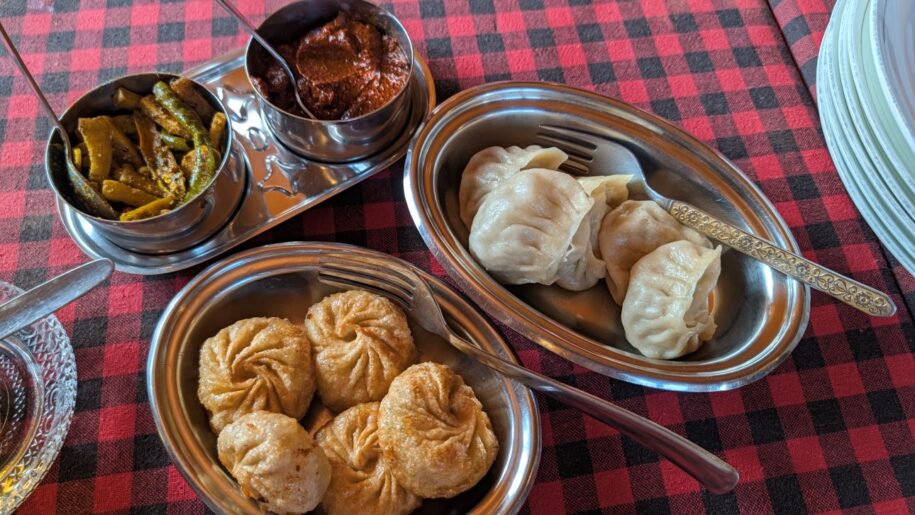
The thick chilli paste was made with ground chillies, which we were told included the local Urka variety, a shorter, rounder chilli associated with Bhutan. Its appearance was a smooth puree with a deep red hue, warning us of the potential mouth numbing challenge ahead.
Our table quickly divided into two camps. Some happily dipped their momos into the ezay without so much as blinking, while others found themselves wincing, tearing up and quietly contemplating their next mouthful. Bhutanese chilli tolerance is clearly not something to be underestimated.
Alongside the Ezay came a serving of pickled green chillies, which offered yet another interesting discovery. Unlike the sharply acidic pickles commonly encountered in Southeast Asia, Korea or Japan, these had a milder tanginess, with mustard oil and spices contributing a distinctive savoury character. If the Ezay didn’t pack enough heat, this little pickled fella took it one notch up.
Together, the dumplings and condiments demonstrated something we were beginning to appreciate about Bhutanese cuisine: seemingly simple food can possess a remarkably bold personality.
Suja – When Tea Becomes a Meal
Although we did not have Suja, Bhutan’s traditional salted butter tea, at Sonam Trophel, it deserves a mention as part of our culinary journey through the country.
Suja is traditionally prepared by brewing strong tea and vigorously churning it with butter and salt, often using a wooden churn. For those accustomed to sweetened milk tea, the idea of drinking salted butter might sound rather peculiar, but in Bhutan’s cold Himalayan climate, this calorie-rich beverage has long served a practical purpose.
The Suja we sampled elsewhere was surprisingly mellow. There was little of the overpowering buttery aroma we had anticipated, and the saltiness was gentle rather than aggressive. When we added Zaow, Bhutanese toasted puffed rice, to the tea, the experience became more interesting. The rice introduced a wonderful nutty, toasted fragrance that complemented the savoury notes of the drink, while its slightly crunchy texture provided a welcome contrast to the richness of the butter.
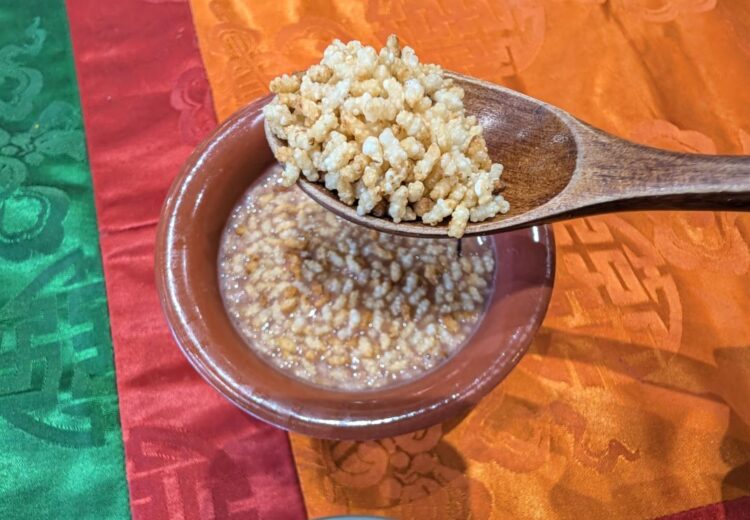
What might initially seem like an unusual beverage suddenly made perfect sense. In a mountainous environment where warmth and energy are essential, combining fat-rich butter tea with carbohydrate-dense toasted rice creates a convenient, nourishing snack. For generations, such food traditions have helped sustain farmers, monks and travellers through the demanding Himalayan climate.
A Humble Meal Worth Remembering
There is something refreshing about Sonam Trophel Restaurant. It doesn’t rely on elaborate interiors or theatrical presentations to impress its customers. The dining room is modest, the atmosphere welcoming and the food speaks confidently for itself. We also appreciated the cleanliness of the establishment and its orderly kitchen, particularly reassuring for travellers who may be cautious about unfamiliar food while overseas.
More importantly, the restaurant gave us an opportunity to experience a cuisine that remains relatively unfamiliar to many international visitors. From the comforting richness of Ema Datshi to the smoky intensity of Sikam Paa and the fiery personality of Ezay, each dish offered a small glimpse into Bhutan’s geography, history and culinary traditions.
We cannot say with certainty how Sonam Trophel compares with every other Bhutanese restaurant, nor would we pretend to be authorities on what constitutes the definitive version of each dish. That would require far more meals, conversations and time spent understanding the country’s food culture.
But we do know this: the food was bloody good, the hospitality was warm, and the experience left us wishing we had discovered the restaurant earlier in our journey.
For anyone visiting Paro, Sonam Trophel is well worth considering for a taste of Bhutanese home-style cooking. And should we have the good fortune of returning to this beautiful Himalayan kingdom, we already know where one of our first meals will be.
Sometimes, the best way to appreciate an unfamiliar cuisine is not to judge it against what you already know, but simply to enjoy what it has to offer.