
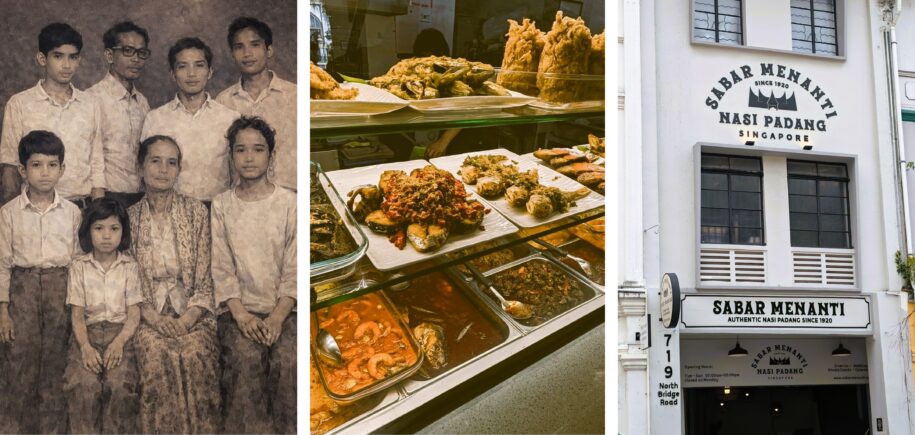
A Century of History, Served with Rice
In a city where restaurants come and go with alarming regularity, surviving a year is already an achievement. Surviving a century, however, is quite another matter. Particularly when that century includes a world war, Japanese occupation, Singapore’s independence and the relentless march of modernisation.
Yet, through all these upheavals, Sabar Menanti has continued doing what it has always done: cooking Nasi Padang.
Its story began in the 1920s when Haji Marlian Athar and Hajjah Rosmah Mailu arrived in Singapore from Indonesia. They started modestly, selling Nasi Padang from a pushcart, with Rosmah patiently preparing the dishes by hand.
The name Sabar Menanti, meaning “Wait Patiently”, apparently came from a customer who gifted the couple a makeshift signboard bearing those words. It was a rather poetic choice. As their food grew in popularity, queues began forming, and customers quite literally had to wait patiently for their meals.
But there was another meaning to those two words. Good cooking, particularly the slow, labour-intensive dishes of Indonesian cuisine, cannot be hurried. Rosmah understood that developing flavours required time, diligence and respect for the cooking process. Perhaps the name reflected her philosophy as much as it reminded hungry customers to be patient.
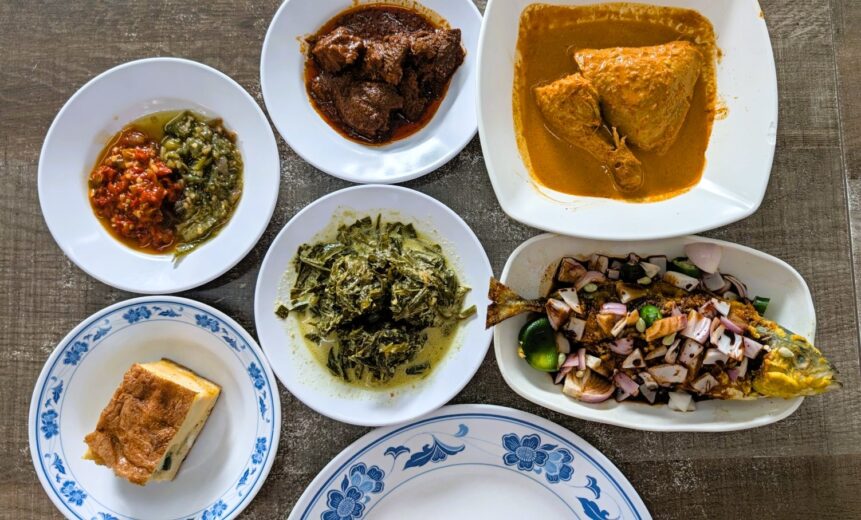
By the 1930s, the business had flourished sufficiently to establish a small restaurant along Bussorah Street. It would go on to witness Singapore’s darkest wartime years under Japanese occupation, followed by the country’s independence in 1965. When the founding couple passed away in the 1980s, their five children carried on the family business. In 1994, their eldest daughter, Maryulis, established Sabar Menanti 2 at 747 North Bridge Road, extending the family’s culinary legacy into another generation.
The restaurant subsequently moved to 737 North Bridge Road in 2022, dropping the numeral from its name, before another rental increase forced a further relocation to its present address at 719 North Bridge Road in 2023. Today, the expanded premises include a second floor for private functions and weddings, while Maryulis’s son, Iszahar Tambunan, affectionately known as Isz, oversees the business.
The Art of Waiting Patiently
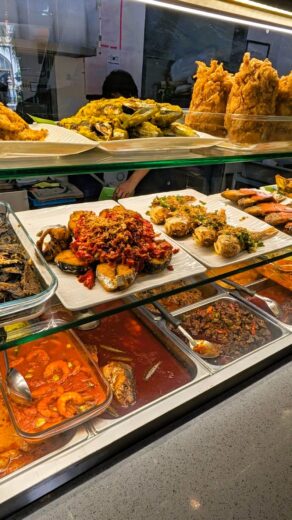
Nasi Padang is one of those wonderful culinary concepts that makes deciding what to eat simultaneously exciting and terrifying. With an assortment of meats, vegetables, curries and sambals spread across the counter, one could conceivably eat here for several consecutive days without repeating a single combination. The terrifying part, of course, is exercising restraint.
At Sabar Menanti, there are no elaborate presentations or complicated ordering rituals. Simply approach the food counter, survey the day’s offerings and point at whatever catches your fancy. The difficulty lies in deciding when to stop pointing.
Much of the cooking remains manual, following traditional methods handed down through generations. One concession to modern technology is the beef rendang, where a mechanical stirrer assists with batches involving some 40 kilograms of beef. Given the hours required to cook rendang properly, even the most devoted traditionalist might forgive this particular innovation.
The restaurant has also adjusted its chilli intensity. After witnessing tourists reduced to tears by the heat, Iszahar decided to moderate the spiciness to accommodate a wider range of palates. Purists accustomed to fiery Indonesian cooking may find the heat restrained, but there is a distinction between reducing spiciness and compromising flavour. Fortunately, Sabar Menanti has stayed true to the latter.
Beef Rendang: Five Hours of Patience on a Plate
If there is one dish that embodies the philosophy behind Sabar Menanti’s name, it must surely be the Beef Rendang.
Preparation begins with aromatics cooked patiently until the spice mixture releases its oil, a crucial stage in developing depth and fragrance. Beef is then introduced and allowed to simmer for approximately five hours, gradually absorbing the spices as the coconut milk reduces and caramelises.
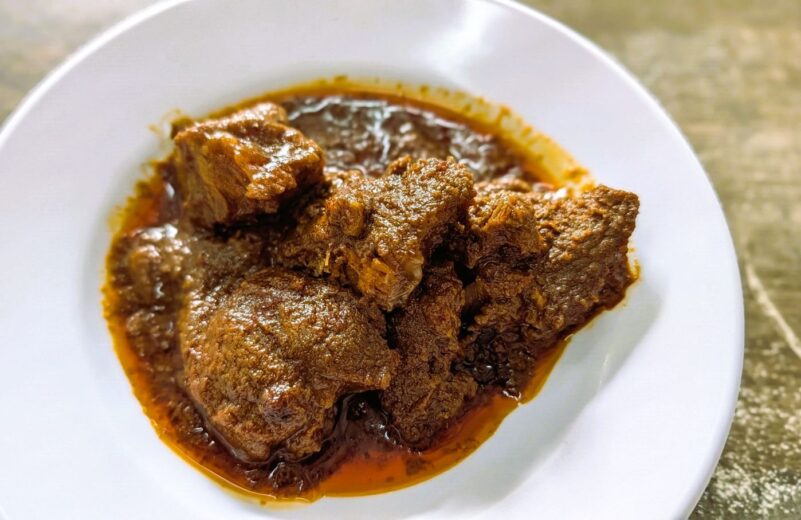
There is almost an unspoken etiquette to enjoying a good beef rendang. As tempting as it may be to attack those tender chunks with unbridled enthusiasm, a little restraint goes a long way. We found immense pleasure in gently teasing the beef apart with our spoon, watching the meat surrender into delicate flakes before savouring each small mouthful. Through hours of patient simmering, the beef’s natural juices have melded beautifully with the coconut milk and spices, gradually reducing into a deeply caramelised coating that clings lovingly to every piece of meat. The result is an intensely rich concentration of savoury, nutty and gently sweet flavours that deserves to be appreciated in small bites. Taking enormous mouthfuls would almost seem disrespectful to the patience and craftsmanship that went into its preparation. Besides, when something tastes this good, why rush to finish it?
Ayam Opor: Comfort in a Coconut Curry
While rendang commands attention through its deep, concentrated flavours, ayam opor takes a gentler approach.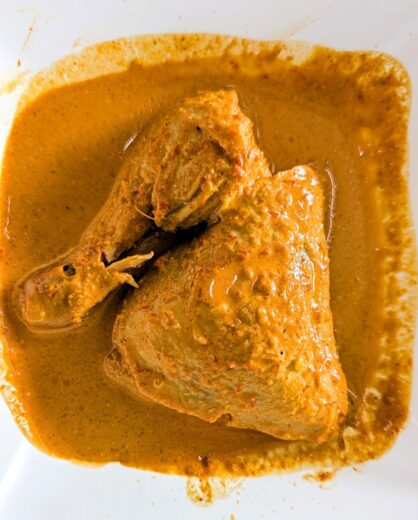
Originating from Central Java, Ayam Opor is chicken braised in coconut milk seasoned with aromatic spices. Unlike fiery Indonesian curries, it is deliberately mild, relying on fragrance, creaminess and a delicate balance of savoury and sweet notes.
Sabar Menanti’s rendition is particularly pleasing for its beautifully restrained lemak, that unmistakable richness of coconut milk. Unlike a typical chicken curry, where the gravy is often heavier and more assertive, the opor is remarkably light yet distinctive. Its delicate richness settles over the palate like a gentle veil, teasing the taste buds with just enough flavour to beckon another bite. With each successive mouthful, the flavours gradually build, revealing the subtle complexity and fragrance of the fresh bumbu. It is a dish that doesn’t overwhelm the palate but quietly seduces it, allowing its flavours to unfold with every bite.
The kitchen insists on using fresh coconut milk rather than pasteurised alternatives, a commitment we believe contributes significantly to the dish’s fragrance.
Ikan Bakar: An Unexpected Love Affair with Onions
Raw onions can be rather divisive. Some diners welcome their sharpness, while others regard them as an immediate threat to pleasant conversation after lunch. Sabar Menanti’s Ikan Bakar arrives beneath a generous mound of chopped red onions, enough to make an onion sceptic contemplate retreat. But beneath this seemingly intimidating topping lies a thoughtfully prepared fish.
The horse mackerel is first marinated in a paste of turmeric, onion and candlenut before being grilled, allowing the earthy fragrance of turmeric and the velvety aroma of candlenut to permeate the fish. Once grilled, a generous layer of sambal is spread over the fish, followed by chopped red onions and a drizzle of sweet, dark kicap manis. A final squeeze of fresh lime completes the dish.
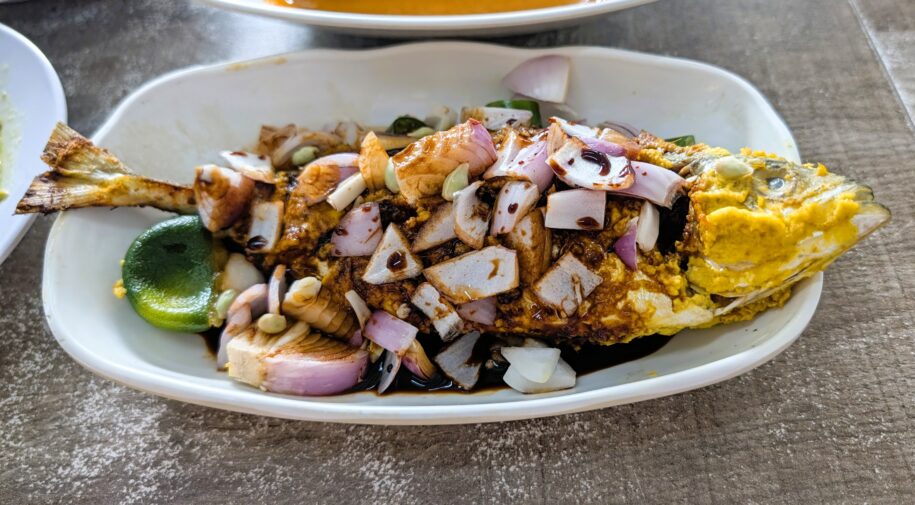
The magic happens when everything comes together in a single mouthful. The kicap manis tames the onions’ pungency, transforming their aggressive sharpness into a gentle sweetness, while their remaining crunch provides a refreshing contrast to the fish. The sambal adds savoury depth and chilli warmth, while the lime cuts through the richness with a refreshing tang. Beneath these toppings, the horse mackerel’s naturally pronounced flavour remains wonderfully distinct.
Telur Dadar Padang: The Humble Omelette That Demands Respect
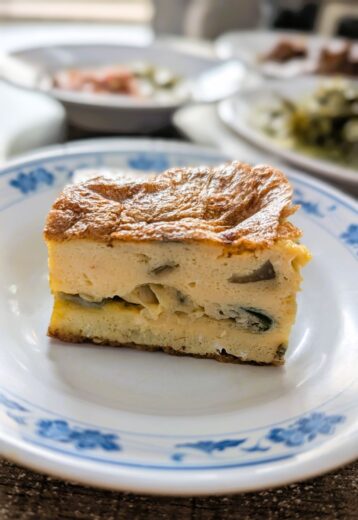
Both the top and bottom possess a beautifully even golden-brown exterior, while the interior remains tender and light. Achieving this balance in an omelette of such thickness requires careful temperature control. Too much heat and the exterior burns before the centre cooks. Too little and the omelette becomes dense, greasy or unpleasantly soggy. The eggs retain a pleasing softness, while the onions embedded within have softened sufficiently to lose their raw pungency yet retain a delicate crunch. Each bite delivers a lovely contrast between the gently browned exterior and pillowy interior, punctuated by the subtle sweetness of cooked onions.
We arrived rather late for lunch, which is unfortunate, because we can only imagine how gloriously crisp the exterior golden edges must be when freshly cooked. Even without that fleeting crispness, the omelette remained thoroughly enjoyable. It demonstrates just how much craftsmanship can be hidden inside something so ordinary.
Sambal Merah and Sambal Ijo: When Even the Oil Is Delicious
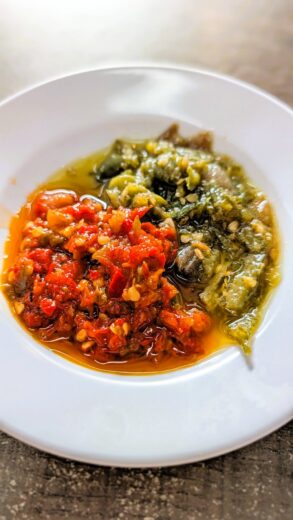
Both sambals possess a lovely mellow smoky character, with the aromatic oils carrying the essence of the chillies and onions. A lovely variation from the bright and heat-punching versions of sambal that are found in other establishments.
And this is where we must confess to a rather indulgent moment. We found ourselves deliberately scooping up the chilli-infused oil and spooning it over our rice. Ordinarily, adding extra oil to an already rich meal would seem unwarranted. But this oil was so beautifully fragrant and savoury that resisting it felt like an unreasonable exercise in self-denial.
Kuih Lopes: A Sweet Ending Worth the Calories
Dessert was never part of the plan, but we were tipped off about a rather special traditional treat that we would supposedly regret missing. Kuih Lopes, with its roots in Javanese culinary traditions, is a wonderfully indulgent dessert made from glutinous rice infused with pandan, wrapped in banana leaves and steamed until tender.
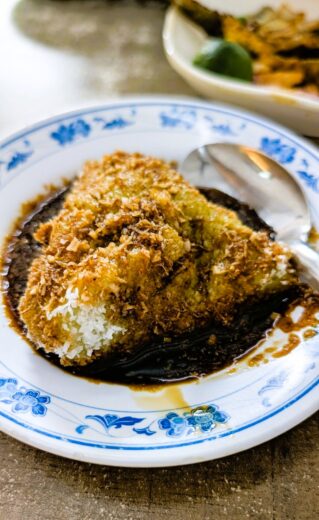
It is rich, fragrant and unapologetically indulgent, yet the simplicity of its ingredients allows each component to remain distinctive. Those watching their waistlines may wish to designate this as a cheat-day treat, although we suspect that after the first mouthful, all such negotiations would become rather irrelevant.
Why a Century-Old Recipe Still Matters
For older Singaporeans, a meal at Sabar Menanti may evoke memories of a very different Singapore, when meals were prepared from scratch, spices were patiently cooked over the stove and the aroma of freshly made rempah was as familiar as the bustle of the neighbourhood. Food was not merely sustenance; it was part of family life, community and the everyday rituals that connected generations. These familiar flavours have a remarkable ability to transport us back to meals shared with parents and grandparents, when a simple plate of rice accompanied by a few lovingly prepared dishes was more than enough to make a satisfying meal.
Nostalgia alone is not what makes Sabar Menanti relevant today. While younger diners increasingly seek the convenience of quick meals, Sabar Menanti continues to take its time in the kitchen, preparing wholesome food without compromising the craftsmanship behind it. Here, one can enjoy the convenience of a ready meal without sacrificing the quality and authenticity of food thoughtfully prepared from scratch.
There is also a rather amusing irony in how we appreciate our own food heritage. Rendang has earned international admiration, celebrated by food lovers far beyond Asia for its extraordinary depth of flavour and culinary craftsmanship. Yet back home, where generations have perfected the dish, we often regard it as just another accompaniment to rice. We enthusiastically seek out the latest artisan bakeries, admire the craftsmanship behind their creations and happily pay a premium for something made with care. But when it comes to a good rendang, we rarely stop to appreciate the skill involved in coaxing humble ingredients into such remarkable complexity. Perhaps familiarity has made us take our own culinary treasures for granted. After all, if the rest of the world can recognise the brilliance of rendang, shouldn’t we be among its greatest admirers?
Perhaps that is what makes Sabar Menanti such a meaningful part of Singapore’s culinary heritage. It offers more than a taste of the past; it demonstrates that the principles of good cooking are timeless, regardless of how much the world around us changes. A century ago, customers were reminded to Sabar Menanti – Wait Patiently. Today, the name feels like a quiet promise that some things are still worth taking the time to do properly.