
If you’ve eaten out enough in recent years, you’ll start to notice a pattern. Somewhere along the way, food stopped being allowed to simply be food. A perfectly good fish is no longer just a fish—it has to be “reimagined,” “elevated,” or “reinvented,” usually accompanied by a sauce that arrives with more explanation than most novels. Dining has slowly become performance art, where ingredients are often expected to justify their existence before you’ve even taken a bite.
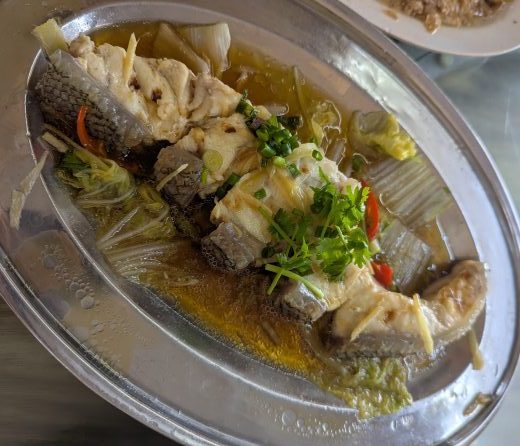
At Ah Seng Restaurant, none of that seems to have made it through the door. The fish arrives without ceremony or narrative framing. There is no dramatic plating, no attempt to convince you of its emotional journey, and certainly no unnecessary reinvention. It is simply fish, presented in a way that suggests confidence rather than insecurity. And strangely enough, that quiet restraint is exactly what makes it stand out in a world obsessed with doing more.
Ah Seng has been running this restaurant for over 50 years, and that number alone carries a kind of weight that no branding exercise can replicate. This is not a revived heritage concept or a nostalgic reboot designed for modern diners. It is continuity—unchanged, uninterrupted, and entirely uninterested in reinventing itself for relevance. The same family still runs the kitchen, with Ah Seng, his wife, and their sons working together as they always have. There is no marketing story trying to dress it up, no curated identity built for social media consumption. What you see is not a carefully constructed version of authenticity—it is simply what has always been there.

One of the first things that catches visitors off guard is the absence of a menu. In a dining culture where choice is often treated as a form of luxury, this can feel almost disorienting. Instead, you ask what is available, and the family tells you, casually and without fanfare. It is less of a transaction and more of a gentle alignment with what the kitchen has already prepared to do well. For locals, this feels familiar, even comforting. For newcomers, it is a quiet reminder that not every meal needs to be designed by the person eating it.
The fish itself comes fresh from Pontian, a coastal town in Johor known for its supply of seafood. Depending on the day, you might find red snapper, pomfret, giant grouper, sea prawns, or occasionally soh-mei. Freshness here is not used as a marketing adjective but as a lived reality, visible in the texture and natural sweetness of the flesh. The preparation, however, remains deliberately singular.
There are no variations or customisations offered—no Hong Kong style, no Teochew style, no modern reinterpretations. The fish is steamed, and only steamed, in what has become unmistakably Ah Seng’s way.
When the dish arrives, its simplicity almost feels like an understatement. A whole steamed fish rests quietly on a bed of napa cabbage, with no garnish vying for attention or visual theatrics trying to elevate its presence. But once you taste it, the restraint begins to make sense. The cabbage beneath adds a subtle sweetness, rounding everything into a harmony that feels deliberate but never forced. The soy sauce does not dominate the fish; it elevates it.
The soy sauce used here is not just a standard condiment but something developed over years and now produced specifically for the restaurant. It is light-coloured in appearance, almost modest, yet it carries a depth that unfolds slowly—layered umami, balanced saltiness, and a quiet complexity that supports rather than overwhelms.
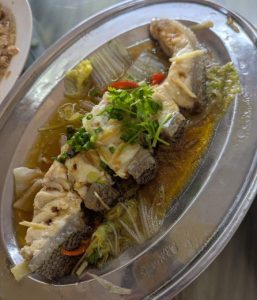
Proper handling and freshness mean the flesh is tender, clean, and naturally sweet, flaking apart with minimal effort. It is a reminder that when ingredients are good enough, intervention often becomes unnecessary.
In fact, the dish quietly challenges the modern habit of overcomplication, showing how much can be achieved with restraint rather than addition. Even something as unglamorous as rice receives proper attention here. It is fragrant, fluffy, and cooked with care, each grain distinct enough to carry the sauces from their various dishes without turning into mush. It plays its role exactly as it should, supporting the meal rather than fading into the background. In many ways, it reflects the same philosophy as everything else on the table: when the basics are done right, everything else falls into place naturally.
The Supporting Cast
While the steamed fish is the centrepiece, the other dishes hold their own without trying too hard. Nothing feels like it was added for variety’s sake.
The Pineapple Fish arrives golden and crisp—deep-fried red snapper draped in a playful combination of mayonnaise and Thai chilli sauce. It’s sweet, tangy, slightly indulgent, and unapologetically crowd-pleasing.
The Fish Paste in Fish Skin is expertly made to look like a complete fried mackerel. The fish meat expertly and delicately removed and made into a paste and reintroduced under the skin. Boneless looking like cuts of mackerel fish steaks with a sweet dark soy dipping sauce.
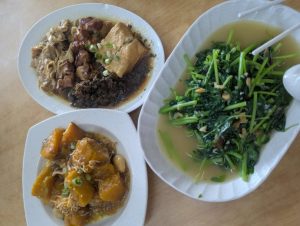
The Braised Platter offers comfort in layers. Beancurd skin that soaks up rich flavours, firm tofu with a satisfying bit, and Dong Po Rou – braised pork belly that trembles slightly as your chopsticks approach, surrendering into melt-in-your-mouth richness.
The Bitter Gourd with Salted Egg strikes a balance between bold and comforting. The bitterness is tamed just enough by creamy, savoury salted egg, creating a dish that is both assertive and balanced.
The Stir-fried Clams in wine bring brightness to the table – aromatic, slightly briny, with just enough heat from the wine to keep things lively.
Then there’s the Baby Shrimp Omelette—crispy on the outside, fluffy inside, dotted with tiny shrimp that add texture and bursts of sweetness. Reminds you that eggs, when treated properly, are never boring.
When you add Baby Anchovies in Pumpkin – the sweet pumpkin with its soft texture when contrasted by the savoury saltiness of anchovies and creamy yam chunks makes it a comforting side dish.
Even something as humble as Chinese Spinach in Broth feels thoughtful – clean, soothing, and grounding amidst the richer dishes.
What makes Ah Seng Restaurant particularly compelling is its refusal to change for the sake of change. It does not chase trends, does not add ingredients to sound modern, and does not attempt to reinterpret itself for new audiences. Instead, it continues doing what it has always done: using good ingredients, applying proper technique, and maintaining consistency over decades. In a world that often equates reinvention with progress, this place quietly suggests that refinement might be the more meaningful path.You come here not for surprise, but for reassurance—that food can still be simple, honest, and deeply satisfying.And sometimes, the most respectful thing you can do to a good piece of fish is exactly what Ah Seng already knows how to do very well: absolutely nothing unnecessary at all.