
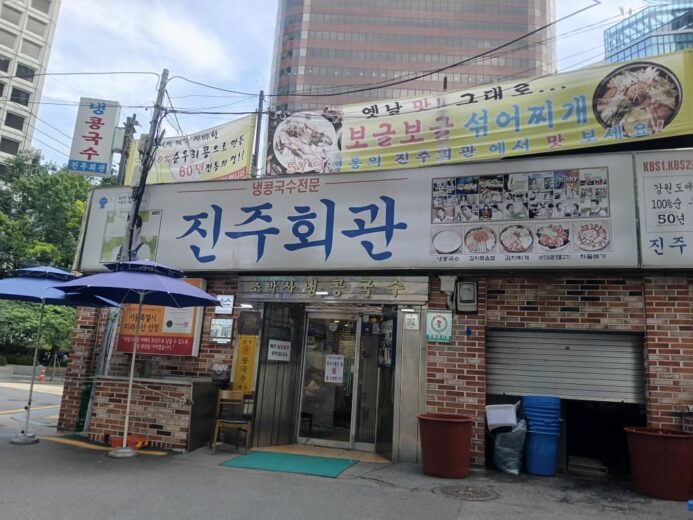
Some dishes impress with complexity. Others win your heart through simplicity. Kongguksu belongs firmly in the latter.
Established in 1962 and now run by its third generation, Jinju Hoegwan has become one of Seoul’s most recognised destinations for kongguksu, a chilled wheat noodle dish served in creamy soy milk broth. Dating back to the late 1800s, kongguksu was originally enjoyed by Korea’s royal family as a nourishing way to stay cool during the hot summer months before eventually becoming a beloved dish for everyone. Rich in plant protein yet surprisingly hearty, it remains one of Korea’s most iconic seasonal meals.
At Jinju Hoegwan, there is little doubt what everyone comes for. Almost every table is served the same bowl, making it feel almost sinful to order anything else.
The noodles are cooked al dente with a pleasant chew that holds its texture beautifully in the chilled broth. Lightly seasoned with salt, the soy milk is smooth, creamy and naturally nutty. The flavours are gentle rather than bold, allowing the nuttiness of the soybeans to shine through. It is a bowl that doesn’t overwhelm but quietly grows on you with every mouthful.
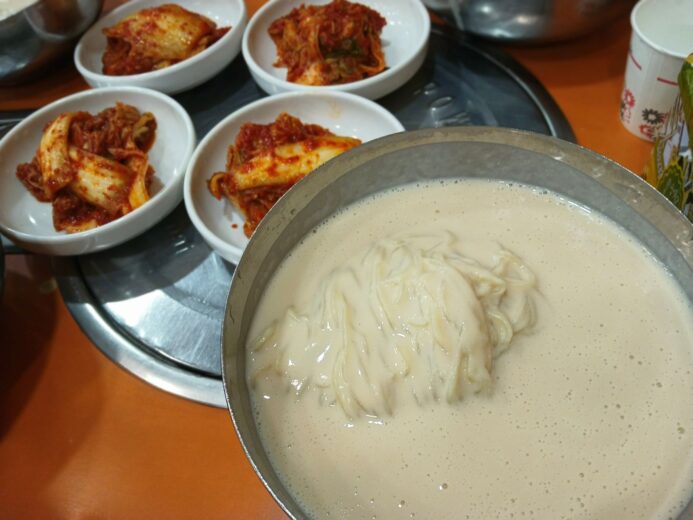
Then comes the restaurant’s house-made kimchi.
Mixed together with the noodles, the entire experience changes. The bright tanginess and satisfying crunch of the napa cabbage cuts through the creamy broth, creating a delightful contrast of flavours and textures. Every bite suddenly becomes livelier. Whether kongguksu is better enjoyed on its own or with kimchi became an unexpected discussion at our table. Among the four of us, nobody disliked the dish, but everyone had a different preference.
We arrived at 1:30pm, only to discover we had just missed the final seating before the staff’s lunch break from 2:00pm to 2:30pm. As we waited, close to a hundred hopeful diners were politely turned away and asked to return before reopening. Even after more than six decades, the queues have not disappeared.
Inside, the restaurant operates with remarkable efficiency. Bowls arrive almost as quickly as new customers take their seats. Young and old alike quietly enjoy the same comforting meal, a reminder that some traditions never lose their place.
If you’re arriving by subway, the stairs and short uphill walk is worth embracing. Think of it as a small way to build an appetite for one of Korea’s most enduring summer dishes.
Simple, honest and timeless, Jinju Hoegwan reminds us that sometimes the quietest bowls leave the longest memories.