
But long before permanent hawker stalls, food courts and Google Maps pins, Wanton Mee in Penang was affectionately known as “Kok Kok Mee.” Vendors would ply the streets carrying their noodles and announce their arrival by striking two pieces of bamboo together. Kok kok, kok kok. For those waiting at home, that familiar sound meant one thing: noodles were nearby.
Today, the typical Penang-style Wanton Mee is served with springy egg noodles tossed in a dark soy-based sauce, accompanied by char siew, vegetables and wantons.
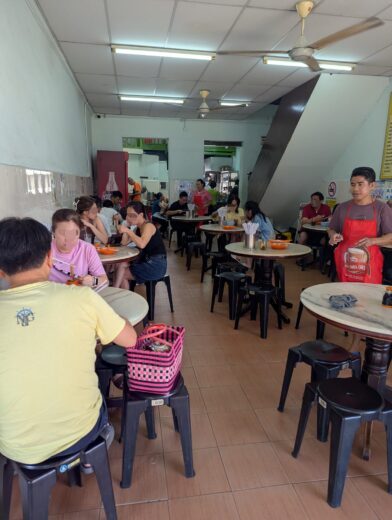
At Pulau Tikus Wanton Mee House, however, somebody decided to break the rules.
Not Your Usual Wanton Mee
At first glance, there is everything you would expect from a proper bowl of Wanton Mee. The egg noodles are cooked with that desirable QQ texture – springy, bouncy and carrying enough bite that they don’t surrender the moment they enter your mouth.
The toppings are generous too. There is enough char siew, vegetables, mushrooms and wantons to accompany the noodles throughout the meal. It sounds like a small detail until you’ve experienced the disappointment of finishing all your toppings halfway through and spending the remainder of lunch eating a lonely mountain of noodles.
The fried wantons deserve a mention as well. Crisp on the outside with a generous amount of flavourful filling within, these aren’t the unfortunate variety where three layers of fried wrapper are concealing a microscopic speck of meat.
But we’re not going to spend the next few paragraphs discussing char siew and vegetables. That would make this a very ordinary Wanton Mee review.
When Wanton Mee Met Char Hor Fun
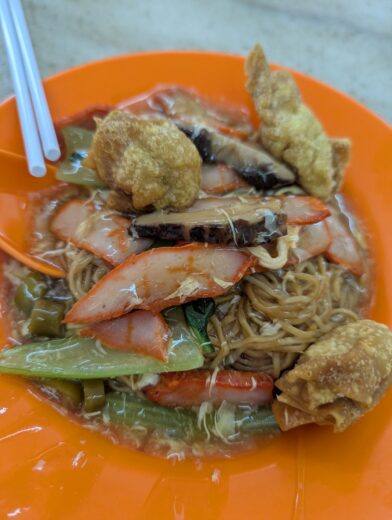
Yes. Egg and cornstarch on Wanton Mee.
It doesn’t immediately sound like culinary genius. Until you slurp it.
The cleverness is that the gravy isn’t intended to dominate the dish. Its purpose is textural. It wraps itself around every strand, giving the noodles an almost silky slipperiness as they glide into the mouth. Then you bite down and meet the contrasting springiness of the egg noodles underneath.
Silky on the slurp, QQ on the bite.
And just when everything seems rather gentle, the crispy pork lard comes through. Little pieces mixed amongst the noodles provide bursts of savoury richness and that unmistakable fragrance of rendered pork fat. Against the mild gravy, they become even more noticeable. The sauce provides the glide; the noodles provide the bite; the pork lard provides the decadence.
Suddenly, egg and cornstarch don’t sound quite so crazy anymore.
A Little Penang Hawker Ingenuity
So how did this unconventional bowl come about?
The inspiration reportedly came from another beloved Penang noodle dish: Char Hor Fun.
Char Hor Fun uses broad rice noodles that are stir-fried before being covered in a glossy egg gravy thickened with starch. Somewhere along the way, the original proprietor had a wonderfully simple thought:
Why not put that gravy on Wanton Mee?
From a traditionalist’s perspective, perhaps there are several reasons why not.
Fortunately, nobody stopped them.
The combination became popular, customers kept returning for it, and what might once have sounded like an odd experiment eventually became its distinctive style of Wanton Mee.
That may actually be the most interesting thing about this bowl.
When Innovation Becomes Tradition
We sometimes speak about traditional food as though there is an invisible rulebook somewhere declaring exactly how every dish must be prepared.
But food culture has never really worked that way. Recipes change. Techniques cross paths. Ingredients become available or disappear. Hawkers observe what their neighbours are doing, experiment with ideas and adapt dishes to the tastes of their customers. Most experiments are probably forgotten.
Occasionally, one sticks. At some point, somebody had to be the first person to do it differently. Here that little act of culinary rebellion resulted in a bowl of silky, springy, pork-lard-fragrant Wanton Mee that still draws a crowd today.
Sometimes breaking the rules is how new traditions are born.
Other Wanton Mee Stories in Malaysia: