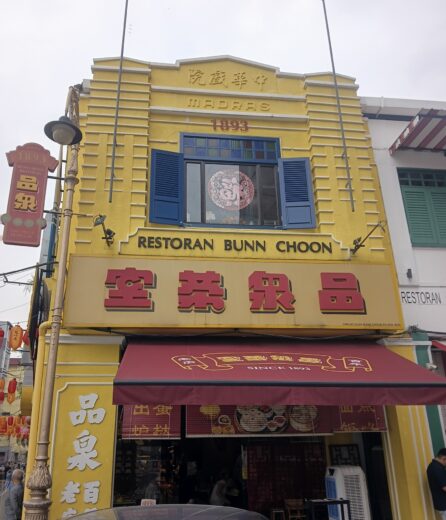
In a corner of Kuala Lumpur’s Chinatown, where old shophouses increasingly share the neighbourhood with cocktail bars, cafés and carefully curated nostalgia, stands Bunn Choon.
Founded in 1893, Bunn Choon is now 133 years old. It is the oldest eatery we have visited on our food journeys to date – and at that age, frankly, it doesn’t have much left to prove.
Bunn Choon actually began as a teahouse, selling only Chinese tea before later generations expanded the business into dim sum and traditional pastries. Wong Kok Tong’s father even travelled to Hong Kong to learn the craft of making egg tarts and mooncakes – treats that would eventually become synonymous with the Bunn Choon name. Today, the family legacy is carried by fourth-generation owner Wong Kok Tong, the founder’s great-grandson.
But its 133-year journey has not been uninterrupted.
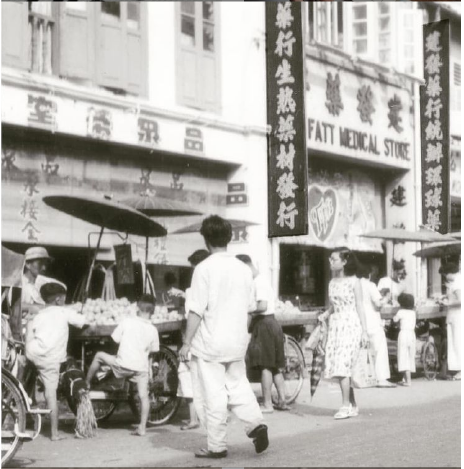
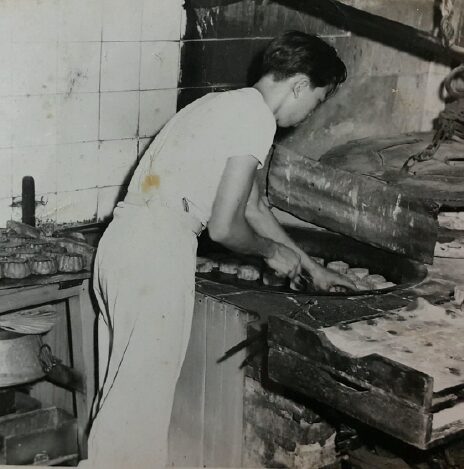
In the early 2000s, soaring rent forced the family to close the business. Unwilling to let more than a century of family history disappear, Wong started again rather humbly – setting up a small stall in front of the old shop and selling handmade Chinese pastries. He worked morning and night markets before establishing a stall at Imbi Wet Market in 2008, where egg tarts and mooncakes became part of his offering.
After several moves around Kuala Lumpur, Bunn Choon eventually returned to Chinatown, opening its present Jalan Balai Polis home in 2023 – less than a ten-minute walk from where the family’s story began at 61 Petaling Street.
Perhaps that makes Bunn Choon’s story even more meaningful.
Heritage doesn’t survive simply because something is old.
Sometimes, somebody has to decide that it is worth saving.
A Window Into Old Kuala Lumpur
Bunn Choon has changed too.
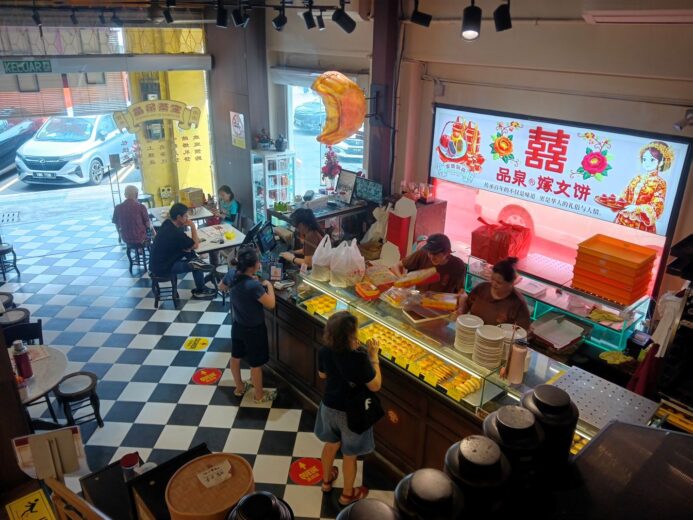
Its handsome yellow façade certainly isn’t pretending that the last 133 years didn’t happen. Yet what interested us more were the smaller things inside.
At the table sat that quintessential pot of hot water for rinsing and sanitising your own tableware. Nearby was an old-fashioned thermos flask – the sort many of us would remember from the homes of our parents or grandparents – there for customers to refill their own Chinese tea.
Neither is particularly glamorous.
Which is precisely why we liked them.
Plenty of restaurants today spend considerable money trying to manufacture nostalgia. Here, some of the experience simply continues because that’s how things have always been done.
We found ourselves seated beside a window overlooking the street. Looking down at modern Chinatown, it wasn’t difficult to imagine an earlier Petaling Street filled with pushcarts, hawkers and pedestrians going about their day.
For a moment, it felt like a small window through time.
Har Gow
The Har Gow (Prawn Dumpling) arrived with somewhat translucent skins, the pink-red colour of the prawns peeking rather cheekily through their wrappers.
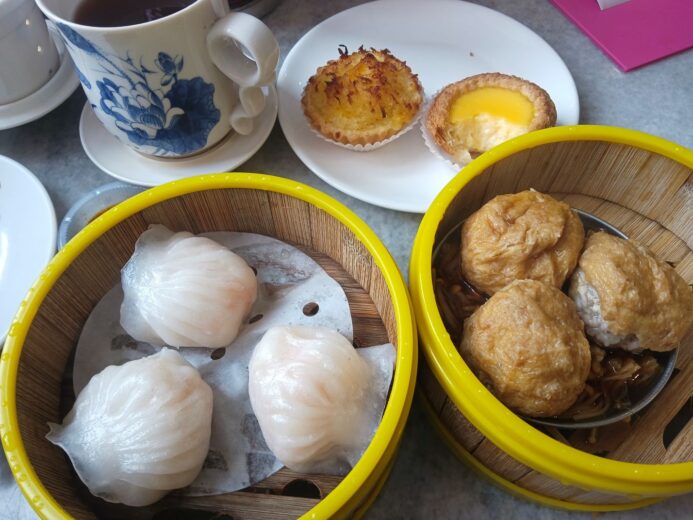
The skin wasn’t the thinnest we’ve encountered, but that turned out not to be a criticism. It had a gentle stretchy chew that worked nicely against the firm, crunchy prawns inside.
There was substance to it.
Sometimes we become so obsessed with dim sum skins being impossibly thin that we forget they still have to survive the journey from steamer to chopsticks.
Char Siew Cheung Fun: Don’t Judge a Roll by Its Cover
The Char Siew Cheung Fun (Char Siew Rice Rolls) initially worried us.
One look and the rice rolls appeared rather thick. And thick cheung fun skin is generally not something that causes spontaneous applause around our table.
Then we took a bite.
We owed the kitchen an apology.
What appeared to be one thick sheet was actually thin rice skin wrapped continuously into delicate layers. The moment it entered the mouth, those layers yielded almost effortlessly before revealing pieces of char siew within.
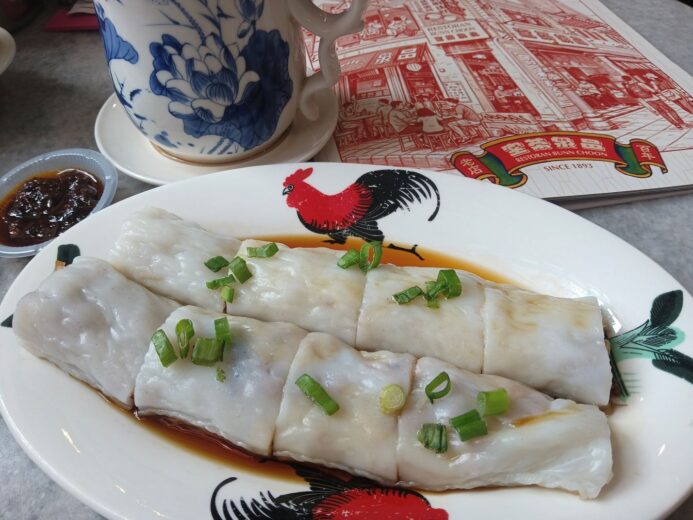
The ratio was excellent. Enough pork to make its presence known, but not so much that the rice roll became merely a delivery vehicle for meat. The char siew had sufficient fat to remain moist, while its sweetness played against the savoury soy sauce bathing the rolls.
Then came a dollop of dried-shrimp chilli paste. Salty, spicy and packed with shrimpy umami, it pulled the whole dish away from becoming overly sweet.
Never judge a cheung fun by its apparent thickness.
Lesson learnt.
When Siew Mai Met Bak Kut Teh
Then came something decidedly less traditional: Bak Kut Teh Siew Mai.
We approached this with some suspicion. After all, sometimes “innovative” is simply a polite culinary word for someone had an idea and nobody stopped them. But this one made sense.
Siew mai carries the Cantonese heritage of dim sum, while Bak Kut Teh (Pork Herbal Soup) has become deeply embedded in Malaysian Chinese food culture. Bringing the two together felt less like a gimmick and more like a little nod towards how immigrant cuisines take root and develop identities of their own.
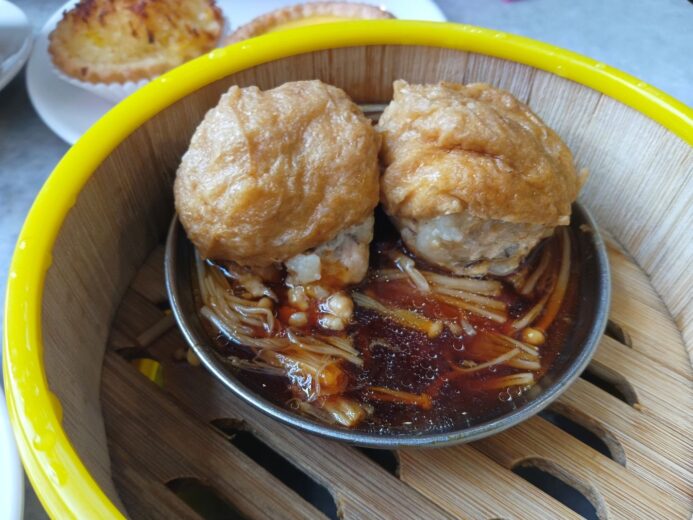
Instead of wanton wrapper for skin, it has been replaced with puff tofu which is a common ingredient in Bak Kut Teh. The familiar herbal character of Bak Kut Teh came through in the meaty filling, which remained firm yet tender. This contrasted beautifully with the airy puff tofu, its porous interior soaking up the savoury juices from the meat filling like a sponge. A glossy, starch-thickened sauce gave everything a smooth richness, while enoki mushrooms contributed a welcome little crunch.
It certainly wasn’t something Bunn Choon would have served in 1893. And that’s the point. Preserving heritage doesn’t necessarily mean freezing it in time.
The Great Tart Duel
Of course, we couldn’t come to Bunn Choon without ordering its famous egg tart.
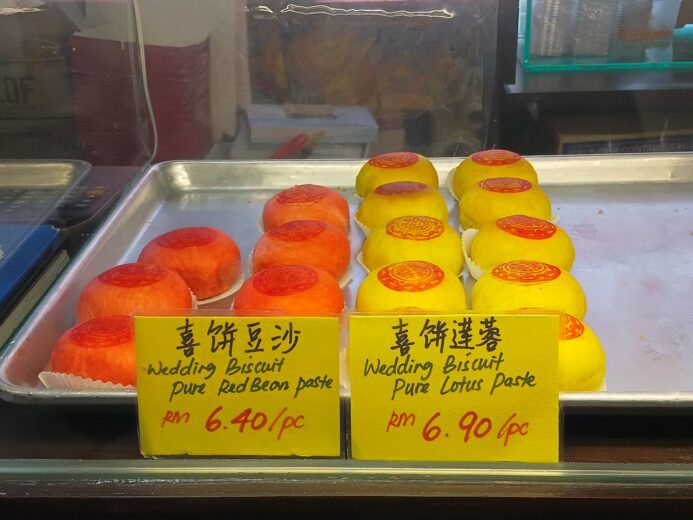
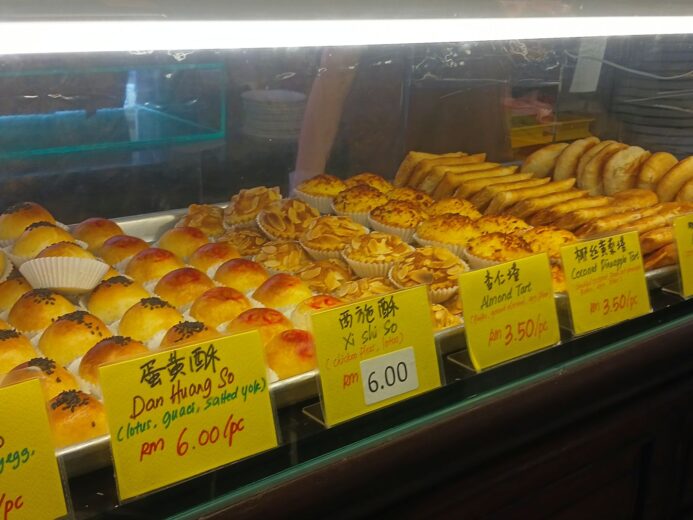
Downstairs, the pastry counter displays enough traditional Chinese pastries to severely test anyone’s commitment to moderation. Alongside the egg tart, another increasingly uncommon old-school favourite caught our attention: the coconut-pineapple tart.
And so began the Great Tart Duel. First, the egg tart.
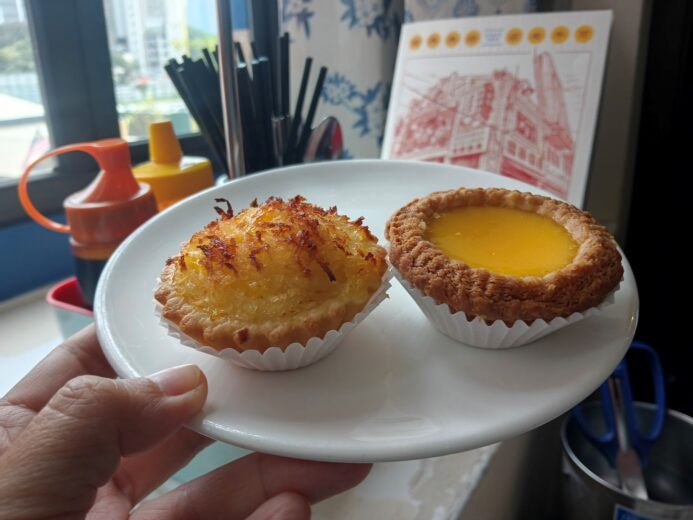
The custard was beautifully eggy without becoming offensively eggy – an important distinction. It was soft and smooth, with none of those little trapped air bubbles interrupting its silky texture.
But it was the pastry shell that stopped us.
Crisp, crumbly and wonderfully fragrant, it possessed a richness we initially couldn’t quite identify. There was something else lingering in the background – a subtle savoury note. At the time, we even wondered whether we were tasting a faint smokiness.
We bought another four to take away. Purely for research, naturally. Four egg tarts later, we were still none the wiser.
Only afterwards did we discover the answer: Pork lard.
Bunn Choon uses pork lard in its egg tart pastry, giving the crust that distinctive savoury richness beneath the sweet custard. It’s this contrast that precisely makes the tart so memorable. The custard brings sweetness and delicate egginess, while the pastry quietly works in the opposite direction – savoury, fragrant, crisp and rich without becoming overwhelmingly greasy.
Then came the challenger. The coconut-pineapple tart could easily have been heavy. Toasted coconut, pastry and sweetness are not exactly ingredients known for their restraint.
Amongst the coconut was shredded pineapple – that changed everything.
Every bite brought rich, toasted coconut together with the brighter sweetness of pineapple. Neither ingredient bullied the other. The coconut provided richness; the pineapple lifted it.
So who won the Great Tart Duel?
We called it a draw.
The egg tart tasted like fine royalty.
The coconut-pineapple tart tasted like a graceful peasant.
You Can’t Manufacture 133 Years
Perhaps what we admire most about Bunn Choon isn’t any individual dumpling or tart, but how it has evolved without polishing away its identity.
Nostalgia has become fashionable. Old tiles can be reproduced, vintage furniture bought, and a few enamel mugs and sepia photographs can turn a brand-new café into “heritage” by lunchtime.
But history is considerably harder to manufacture.
Bunn Choon’s own history isn’t a perfectly uninterrupted one. The business closed, and more than a century of family legacy could easily have ended there. Instead, fourth-generation Wong Kok Tong chose to revive it – starting humbly with a small pastry stall before slowly rebuilding the family name.
That distinction matters.
Heritage isn’t about freezing something in time. Bunn Choon has moved, closed, restarted and adapted. New creations such as Bak Kut Teh Siew Mai now sit alongside Har Gow, Cheung Fun and traditional pastries. Chinese tea is still poured. Dim sum still arrives in bamboo baskets. Egg tarts still disappear alarmingly quickly from the table. And a fourth generation is still carrying forward a business his great-grandfather began in 1893.
Perhaps that is what living food heritage should look like. Not frozen in the past, but still relevant enough for another generation to believe it is worth saving – and delicious enough for the rest of us to keep coming back.