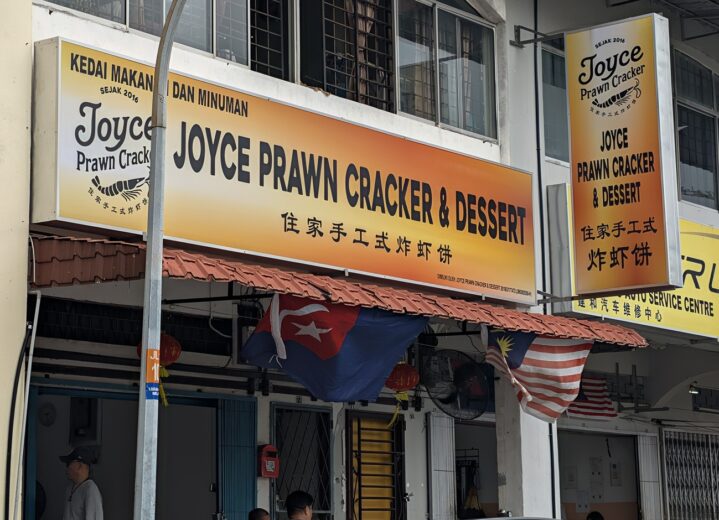
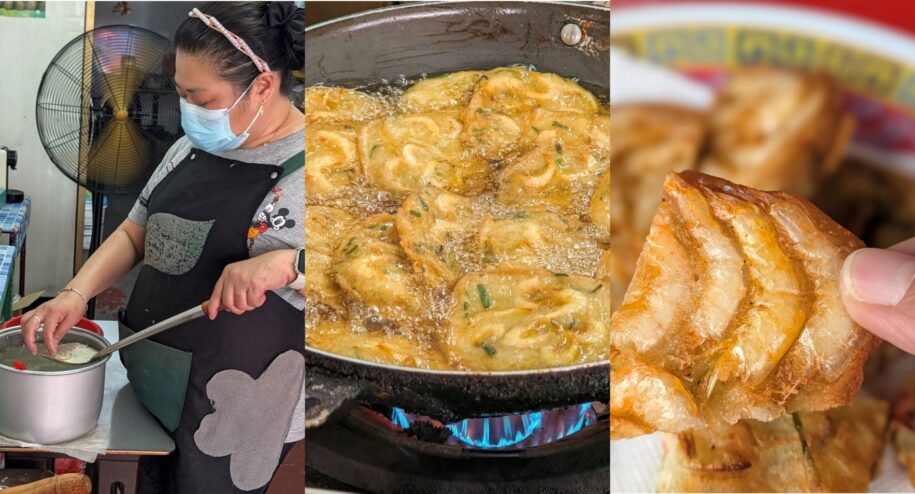
Joyce doesn’t talk much while she’s frying her cucur udang.
She is too busy watching.
One hand works the batter while the other carefully arranges the small prawns across each piece. Her eyes move between the prawns, the hot oil and the flame beneath the wok. There is a quiet concentration about her – the sort that comes when you’ve done something countless times but still refuse to take it for granted.
Watching Joyce work, we quickly realised that cucur udang isn’t quite as simple as it looks.
After all, the ingredients themselves aren’t particularly complicated. Batter, prawns, chives and oil. But knowing what to do with them – and doing it consistently – is another matter altogether.
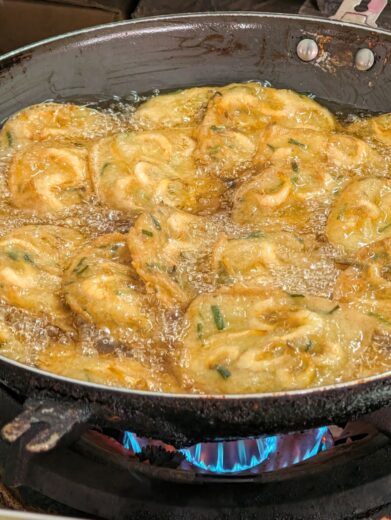
Each piece starts with Joyce carefully placing the prawns onto the batter. Not one lonely prawn positioned ceremoniously in the middle, either. She is generous with them. Small prawns, shells intact, are spread across the surface until there is little doubt about why this is called cucur udang.
Then into the hot oil they go.
This is where Joyce’s attention seems to sharpen even further.
She watches the flame. She watches how vigorously the oil bubbles around each piece. She turns them when needed and somehow keeps track of a wok crowded with cucur udang, each one at a slightly different stage of cooking.
There is no timer announcing that number seven is ready – Joyce just knows.
With a long-handled utensil, she deftly fishes each piece from the fiercely bubbling oil at seemingly just the right moment – golden, crisp and rigid enough to give that very satisfying crunch.
And what emerges is quite a sight.
Hold one up to the light and you can see the prawns embedded across its almost translucent, blistered surface. Their shells have fried crisp, bringing little pockets of savoury sweetness and an extra crunch to every bite. It is wonderfully rustic. No two pieces look exactly alike, nor do they need to.
But perhaps the nicest part of eating Joyce’s cucur udang came from having watched her make them.
Street food can sometimes appear deceptively simple because we only see the finished product. A few ringgit changes hands, a paper packet is passed across the counter, and off we go.
What we don’t always notice are the hands that have repeated the same movements hundreds, perhaps thousands, of times. The careful arrangement of the prawns. The glance at the flame. The judgement of the oil.
And that split-second decision that says:
This one is ready.
Joyce makes all of it look easy.