There was a time when eating your vegetables did not require a smoothie, a superfood label or an Instagram wellness influencer.
The Hakka had “Lei cha (擂茶)”.
Restoran Hakka Thunder Rice is just shy of 30 years old, but it deserves a Humble Mention for serving a decent rendition of a dish that seems to be getting increasingly difficult to find.
Lei cha (擂茶) literally means “pounded tea”, from the Chinese character 擂 (lei), meaning to pound or grind. Traditionally, tea leaves, herbs, nuts and aromatics are ground together using a wooden pestle and ceramic bowl to make the distinctive green herbal broth served with rice and an assortment of vegetables.
There are old stories tracing lei cha back some 2,000 years. One piece of folklore places its origins during China’s Three Kingdoms period (220–280 AD), when the troops of Shu Han general Zhang Fei supposedly fell ill before battle. A local doctor prepared a ground mixture of tea leaves and herbs to restore the soldiers.
Whether the story is history or legend, it reflects something important about lei cha: this was food for nourishment and sustenance.
When travelling meant carrying what you needed with you, ingredients had to be practical, nutritious and able to feed the body. There was little need for elaborate flavouring components.
The ingredients were the flavour.
Fresh herbs gave fragrance, tea brought bitterness, peanuts added nuttiness, while vegetables contributed their own sweetness, crunch and character. It wasn’t a dish built around the easy adjectives of salty, sweet or spicy. It was practical food – nourishing, economical and made from what was available.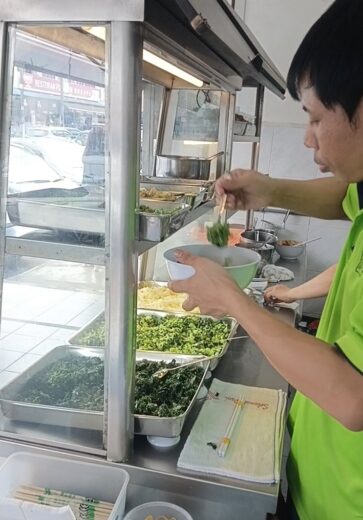
Over generations, lei cha became closely associated with Hakka communities. Preparing it was traditionally a communal effort, with family and neighbours gathering to wash and chop vegetables, stir-fry ingredients and take turns grinding the herbal paste. Hakka families also prepare the dish for Renri (人日), the seventh day of the Lunar New Year.
Perhaps the amount of work involved also explains why lei cha seems increasingly difficult to find today. There isn’t one spectacularly complicated technique. There are simply a lot of little things to prepare.
And our eating habits have changed.
We are accustomed to food delivering bigger and more immediate flavours – more salt, more sugar, more spice, more richness. Against all that noise, lei cha can seem almost too quiet.
At Restoran Hakka Thunder Rice, the vegetables are sliced or julienned into small pieces, showing the amount of care that goes into the preparation. They are fine enough to mix easily with the rice, but not so finely chopped that they lose their texture. The peanuts are nicely roasted and taste fresh.
We opted for brown rice – because once you’ve committed to eating this virtuously, you might as well go all the way.
The green herbal broth was smooth rather than gritty or grainy, although we would have preferred a stronger showing from the fresh herbs. A little more basil, mint and coriander would have given it the more herbaceous character we enjoy in lei cha.
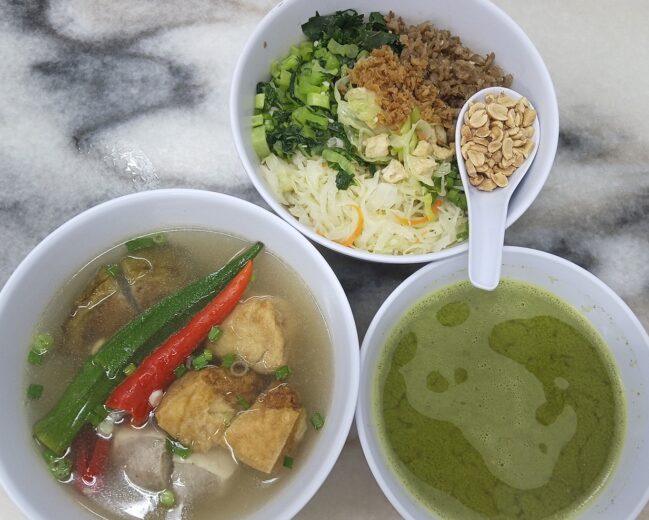
We also ordered the yong tau foo, and thankfully, nobody was being stingy with the fish paste.
Each piece arrived plump and generously stuffed. The fish paste was springy and properly anchored to the okra, chilli and bitter gourd – because few things are sadder in the world of yong tau foo than a huge piece of tofu carrying a miserable teaspoon of filling. Even worse when said teaspoon decides to abandon the tofu altogether.
Here, the proportions were generous and the fish paste pleasantly toothsome. Served in a piping-hot soybean-and-chicken broth, it was mild and light, a lovely accompaniment to the lei cha.
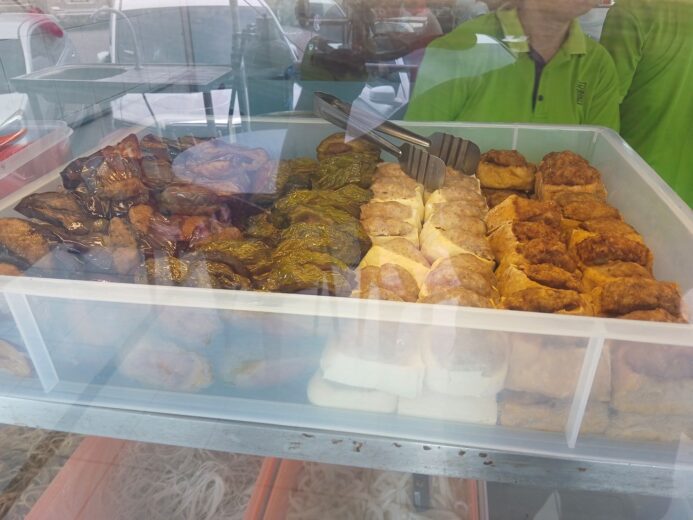
Everything tasted simple and clean. Nothing was particularly robust in flavour – and intentionally so.
That same simplicity extends to the restaurant itself. No frills, no thrills. The décor isn’t waiting to be discovered by an interior-design magazine, and the food isn’t trying to reinvent itself for a younger audience.
What you see is what you get: straightforward Hakka food prepared with care.
On a hazy day, or whenever the stomach asks for something warm, nourishing and uncomplicated, a bowl of lei cha feels rather sensible. Perhaps sensible food simply needs to become fashionable again.
There are several other Hakka cooked dishes on the menu too. Those will have to wait for another day – which gives us a perfectly good reason to return.