Det Lille Apotek: 300 Years of Danish Food, Stories and Secrets
12 October 2026
Copenhagen, Denmark
17 min read
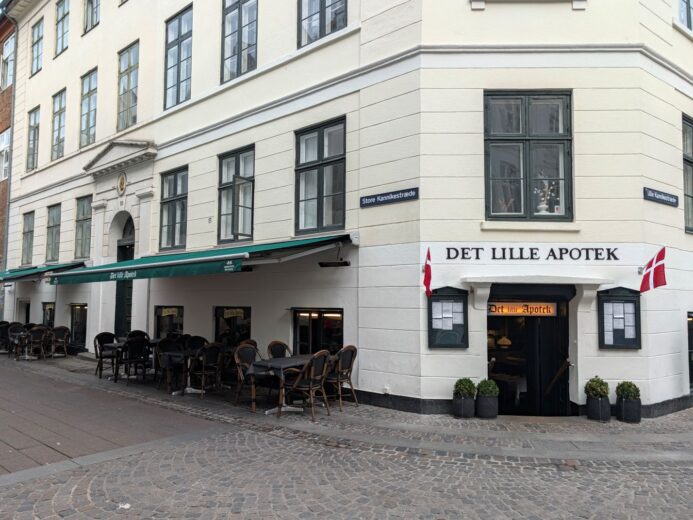
Del lille Apotek reconstructed in 1829 after the great fire in Copenhagen
There are old restaurants, and then there are restaurants where you find yourself wondering just how many secrets the walls have heard.
Det Lille Apotek, meaning “The Little Chemist”, traces its story back more than three centuries, to a Copenhagen that looked very different from the city we know today. The place originally began as a pharmacy dispensing various herbs steeped in spirits, remedies that were apparently popular with Copenhagen’s residents at the time. Considering the city’s population was estimated at only around 40,000 people then, one imagines word of a good medicinal spirit probably travelled quite quickly.
In 1720, Det Lille Apotek opened as a restaurant and coffee house, with the rather agreeable philosophy of providing good, wholesome meals as a form of “medicine”. Three hundred years later, medical science may have moved on considerably, but after eating here, we see no compelling reason to abandon the idea altogether.
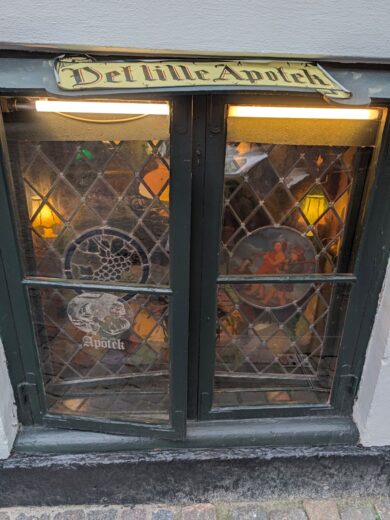
The establishment standing today is not entirely the original from the 1720s. Fire and destruction took their toll on this part of old Copenhagen, and Det Lille Apotek was rebuilt in the early 19th century. Yet much of its historical character survives till today, including several remarkable old hand-painted windows. Walking around the exterior, we found ourselves admiring not only their beauty but the craftsmanship required to make something more than a century ago that continues to quietly perform its original function today. They were not created as historical exhibits; they were simply windows, made beautifully and made to last.
Original handpainted windows from the 1820s
As you descend the few steps from the street into the restaurant, it is difficult to describe the aura of the place. It is by no means lavish, yet there is a dignified sense of majesty about it. Perhaps it comes from knowing that generations of Copenhageners have walked down those steps: students, writers, intellectuals, merchants, lovers and probably a few people who had enjoyed rather too much of the chemist’s original “medicine”.
Sitting inside, one can only wonder about all the conversations that have taken place within these rooms over the centuries – friendships formed, arguments had, romances begun and secrets exchanged. Thousands of people have come and gone, yet the rooms remain, quietly carrying their stories with them.
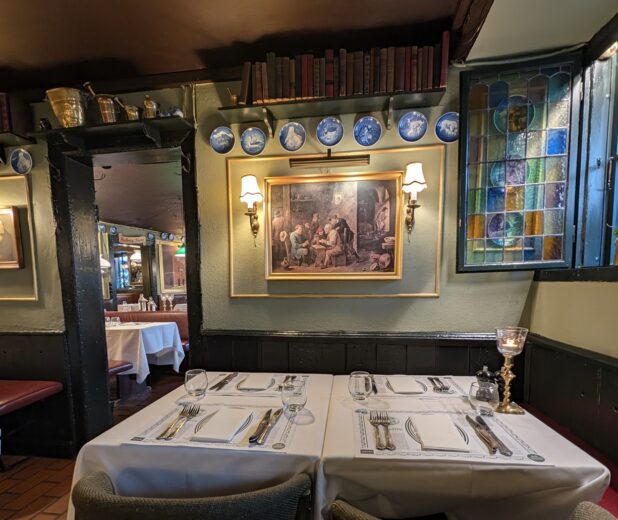
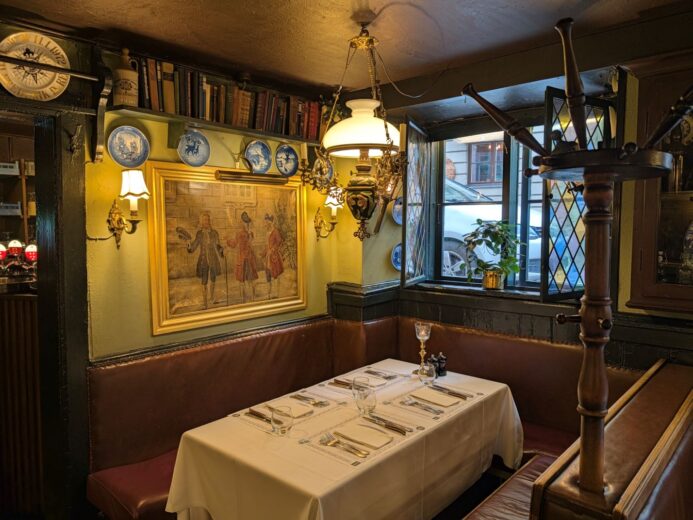
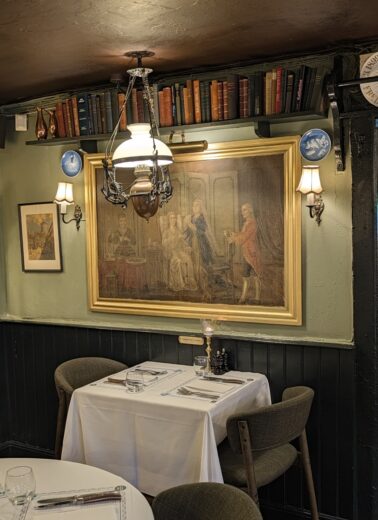
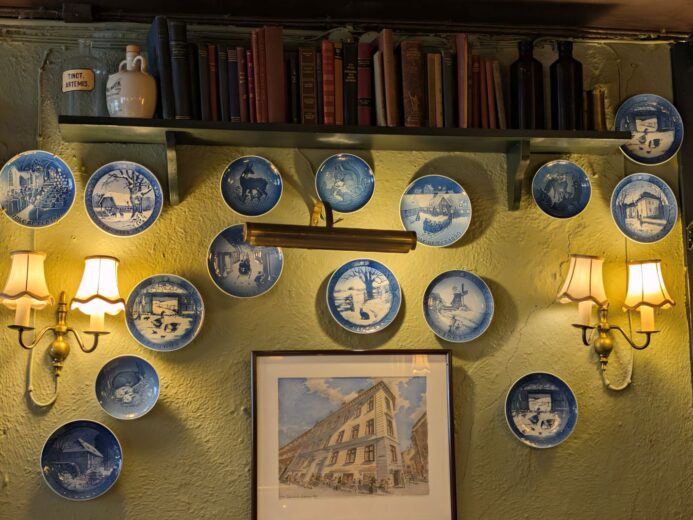
The old hanging lamps, paintings, bookshelves, dark wood and hand-painted windows give the rooms their unmistakable character. What is particularly admirable is how proudly these details have been preserved over the generations. They are not merely decorative reminders of the restaurant’s history; together, they are part of its living heritage, allowing us to experience something of the atmosphere that generations of Copenhageners before us would also have known.
Even a visit to the ladies’ room involves an ascension to the “throne”. We’ll spare you the details.
Hans Christian Andersen Table #5
Among its famous clientele was Hans Christian Andersen, author of The Ugly Duckling and The Emperor’s New Clothes. His association with Det Lille Apotek remains part of the restaurant’s history, and we had the honour of being seated at his famous Table No. 5 in the Holberg parlour. As writers ourselves, there was something especially meaningful about sitting at a table associated with one of the world’s great storytellers. Having sat at Table No. 5, we couldn’t help but feel a little more inspired as we set about telling the story of Det Lille Apotek ourselves.
First prescription: herring
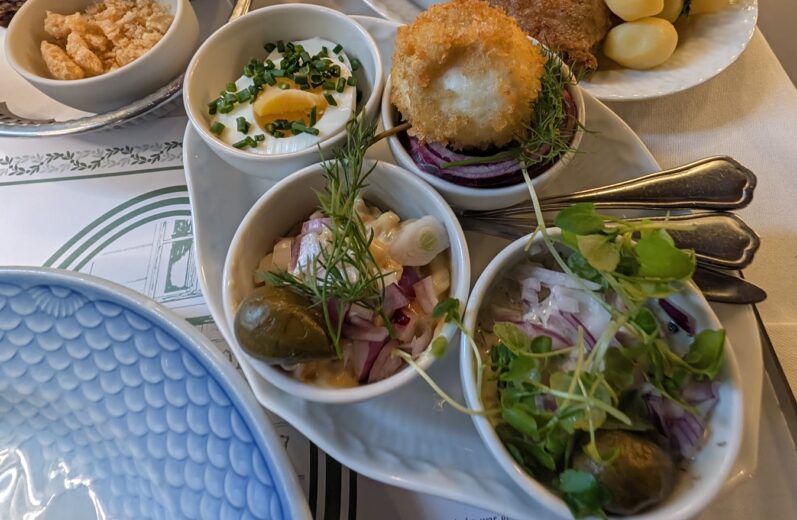
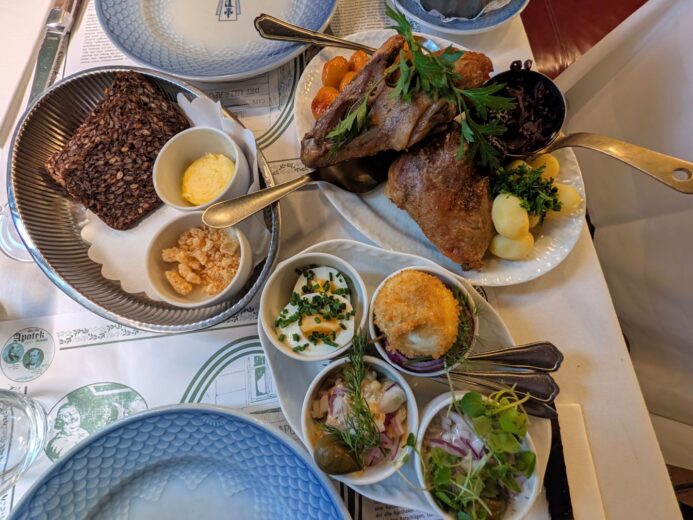
Our first visit was for dinner, beginning with a platter of three herrings: Classic pickled herring with dill and capers; Curry herring with egg, onions and capers; and Fried herring with mustard, onion, beetroot and rhubarb compote.
The culture of eating herring started in the middle ages when the waters between Denmark and Sweden was so full of herring that one could literally scoop them up by hand. Pickling the herring made it easier to transport through the country and last through unfishable months.
For readers unfamiliar with traditional Scandinavian food, the words pickled herring may not immediately cause the stomach to leap with anticipation. The imagination tends to conjure something aggressively vinegary, pungent and so fishy that you might smell it before the waiter reaches the table.
Fear not, dear readers. The herring here was surprisingly gentle, mildly tangy from the vinegar but without the intense fishiness we had imagined. Unfortunately, we cannot show you particularly revealing photographs of the fish itself because most of it was comfortably tucked beneath its various sauces. You’ll simply have to trust us.
Starting with the classic herring was a good introduction before progressing to the curry herring, which had a bolder flavour and was particularly interesting eaten with the egg. When Danes say “curry”, however, Asian readers should recalibrate expectations accordingly. Nobody has secretly poured a Malaysian curry over a herring. The seasoning was restrained, although there was enough familiarity for an Asian palate to recognise where it was heading.
Danish Herring 3 ways @ Det lille Apotek
Spread the different herrings over rye bread and the platter moves between tangy, creamy, mildly fishy, earthy and sweet. Something that initially sounds intimidating becomes a rather civilised little flavour party.
The duck – and those potatoes
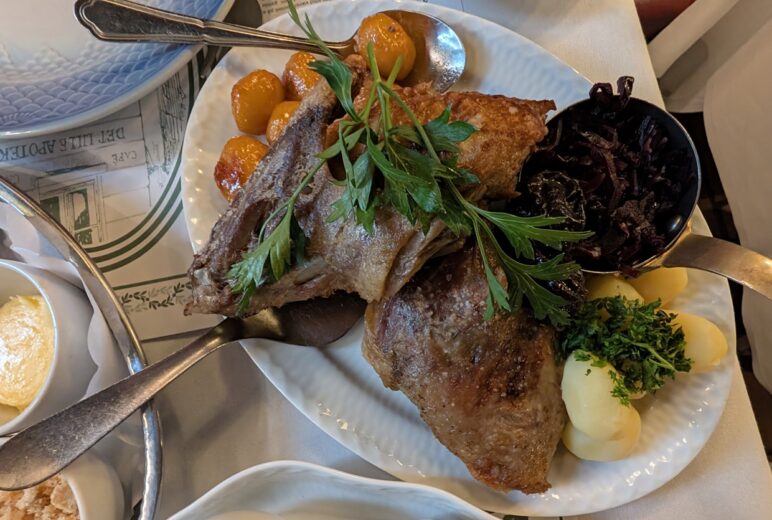
For our main course, we ordered the old-fashioned Roast Duck with Caramelised and Boiled potatoes, pickled red cabbage and gravy. Roast duck has a special place in Danish food culture and is traditionally enjoyed during the Christmas season, so this was more than simply another meat dish on the menu. The duck arrived with crisp skin and tender, moist meat, carrying a deep, rich, roasty and almost mushroom-like savouriness. After an entire day walking around Copenhagen, this was exactly the sort of food the body wanted.
French duck confit receives plenty of international adoration, and deservedly so, but taste a good Danish roast duck like this and it might make you do a double-take. There was nothing particularly elaborate about the presentation; it was simply deeply satisfying, honest cooking.
The unexpected co-star, however, was the caramelised potato. These are not caramelised in the sense that potatoes have simply browned during cooking. Each little potato was enclosed in the thinnest amber-coloured glaze, so delicate you could barely see it until the light caught its surface. They glistened under the restaurant lamps, making their regular boiled-potato cousins sitting beside them look slightly anaemic and underdressed.
Bite through the faintly sticky, mildly sweet exterior and you reach the soft, pillowy potato inside. Such a simple thing, yet absolutely lovely.
Roast Duck with Caramalised Baby Potatoes
Portions at Det Lille Apotek are hearty, and fortunately we exercised restraint. The table of Chinese tourists next to us took a different approach and appeared to have ordered the motherlode. Their magnificent spread produced an immediate attack of food envy, although some time later we could see the battle taking its toll.
This is one of the awkward realities of food writing. Ordering many dishes gives you a broader understanding of a restaurant but can also create unnecessary food waste. Order too little and you wonder whether you have shortchanged yourself on the experience. At The Humble Belly, we prefer to err on the side of zero food waste whenever possible, concentrating our tasting on dishes that are relevant to the food heritage we came to understand.
It also gave us a perfectly legitimate reason to return for lunch.
A courtier in an apron
Restaurant reviews frequently contain the obligatory sentence that “service was excellent”, before promptly returning all attention to the chef. Occasionally, however, you meet someone on the dining-room floor who becomes as memorable a part of the experience as the food itself.
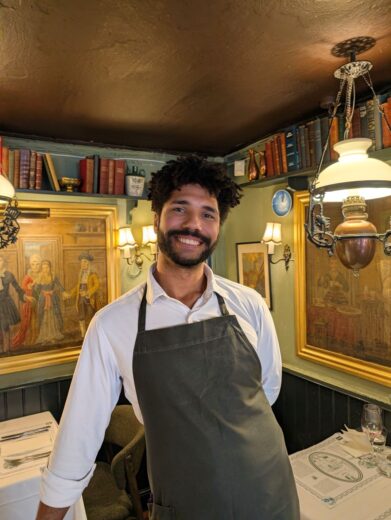
On our second visit, that person was our server, Oliver Carøe.
Oliver possessed the effortless, high-cheekboned Danish charm and manner of an 18th-century courtier who had somehow found himself wearing a restaurant apron. There was an old-fashioned graciousness to the way he spoke and carried himself, attentive without hovering and polished without becoming stiff. More importantly, he understood the difference between merely serving food in a historic restaurant and helping guests understand the history they were sitting inside.
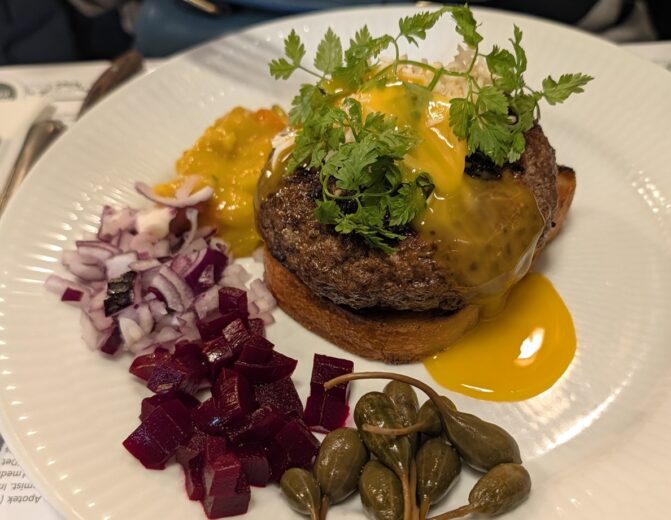
Oliver Carøe "The Courtier in an Apron"We had returned to try the traditional Danish smørrebrød and told Oliver that we wanted a relatively light lunch. With considerable eloquence, he talked us through several possibilities, including the Paris Beef – a ground beef patty served with raw egg and various accompaniments – which he described, with that wonderfully old-fashioned manner of his, as a “gentleman’s lunch.”
Now, we were two ladies sitting at the table, but something about the way Oliver said “gentleman’s lunch” immediately piqued our curiosity. What exactly constituted a gentleman’s lunch in Denmark? Was it particularly hearty? Was this what well-dressed Danish gentlemen of another era ate while discussing literature, politics and matters of great importance over lunch? Whatever it meant, coming from our courtier in an apron, it sounded far too intriguing not to investigate.
So much for our light lunch.
We ordered both the Paris Beef and the Classic Roast Pork.
The Paris Beef turned out to be the more interesting of the two, if only because the combination was unfamiliar to us. The seared ground beef patty with raw egg had a richness and heartiness that made Oliver’s description suddenly seem rather appropriate. Whether it truly qualifies as a gentleman’s lunch, we shall leave the Danes to decide. These two ladies were perfectly happy eating it.
Paris Beef Smørrebrød "A Gentleman's Meal"
The roast pork, unfortunately, arrived rather dry. When Oliver returned to check on us, he seemed to notice immediately that we were not exactly composing poetry about the pork. We gave him our honest feedback and he took it completely on point – no excuses, no fuss. He simply disappeared into the kitchen and emerged shortly afterwards with fresh cuts of roast pork that were considerably better.
Denmark’s good name in roast pork had been restored.
It was a simple gesture, but one we appreciated. Oliver listened, acted immediately and, most importantly, made us feel genuinely looked after. Sometimes the best service is not about everything going perfectly; it is about how naturally and graciously someone responds when it doesn’t.
Unfortunately for our supposedly light lunch, Oliver was equally skilled at another aspect of hospitality: putting the thought of dessert into your head without appearing to sell you one.
Somewhere during lunch, the possibility of a Rum Ball entered the conversation. By the time we finished our smørrebrød, we had somehow convinced ourselves that dessert was necessary and, more importantly, that this decision had been entirely our own.
Well played, Oliver.
As he set the Rum Ball before us, Oliver gave us another little history lesson, explaining how they were traditionally associated with bakeries finding ways to repurpose leftover cakes and breads rather than allowing them to go to waste. The result was dense, chocolatey and deeply satisfying, with a dark richness that made it dangerously moreish.
Fortunately, sanity eventually caught up with us. We still had another historic food destination to visit that afternoon – a century-old patisserie. Such are the hardships of research.
But it was during our conversations with Oliver that Det Lille Apotek’s history became especially vivid. He was the one who drew our attention to the books sitting quietly on the shelves and told us one of our favourite stories about the restaurant.
Long before WhatsApp, email and instant messaging, he explained, the books could apparently serve as a discreet form of communication. People would write letters, slip them between the pages and tell the intended recipient which book to look inside.
Suddenly those old books became considerably more interesting.
One imagines love letters tucked between the pages, discreet appointments arranged, business dealings conducted and perhaps the occasional message that somebody’s husband or wife was definitely not supposed to find.
Just a few of the many books that had carried secrets...
Oliver told these stories with exactly the sort of understated charm that suited the room. He was not reciting historical facts like a tour guide working through a memorised script. His knowledge seemed to come from genuine familiarity with the restaurant, and he knew how to weave its history naturally into the experience without turning lunch into a lecture. His storytelling felt less like a history lesson and more like being let in on a few secrets by someone who happened to know what these old rooms had witnessed.
There was something particularly fitting about hearing these stories from someone with his manner. In another century, one could imagine Oliver carrying a silver tray through exactly these rooms, discreetly pretending not to notice which gentleman had slipped a letter into which book.
The apron may be modern. The courtier appears to have survived.
History you can taste
It is rare anywhere in the world to find a restaurant as old as Det Lille Apotek, but age alone is not what makes this place special. An old building can preserve history, but it is the nostalgic spirit of the food – and, importantly, the fact that the food is still damn good – that brings that history to life.
The herring, roast duck, caramelised potatoes and smørrebrød are more than traditional dishes served in historic surroundings. Eating them here creates a link between modern Copenhagen and the Copenhagen of generations past. For foreign visitors like us, who did not grow up with these foods or the memories attached to them, Det Lille Apotek offers something particularly valuable: an experiential understanding of Denmark’s culinary history. You don’t simply read about it or look at it; for the duration of a meal, you get to participate in it.
That, ultimately, is what makes Det Lille Apotek memorable. Its history may draw you through the door, but the food, the rooms and people like Oliver make that history feel alive. You descend the same old steps, look through the hand-painted windows, sit among paintings and books that have occupied these rooms for generations, and eat dishes that still carry something of Denmark’s culinary past.
The restaurant has changed ownership over the centuries, as any establishment surviving this long inevitably must, but its current custodians have understood that its greatest asset is not simply its age. It is the continuity of its character.
Between our two visits, our preference was for dinner. For an international traveller, the dinner menu offered a more interesting and in-depth introduction to traditional Danish dishes, and the herring followed by the old-fashioned roast duck made for a particularly satisfying experience.
If you are visiting Copenhagen and want a genuinely Danish experience, particularly if you are as interested in history as you are in food, Det Lille Apotek deserves to be high on your list. Advance reservations are recommended, and should you find Oliver Carøe on duty, consider yourself fortunate. Ask him about the restaurant. Ask him about the books.
Just be careful when he starts talking about dessert.
The Humble Belly traditionally writes about Asian heritage food and food culture, documenting the dishes, craftsmanship and people preserving these traditions. But every now and then, we encounter something beyond Asia whose story resonates deeply with what we believe heritage food is about.