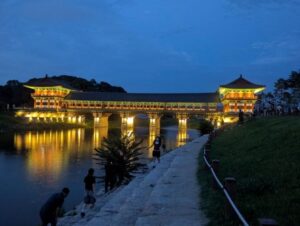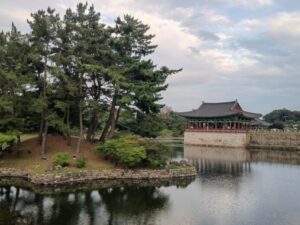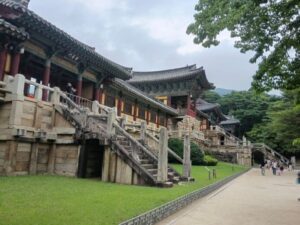
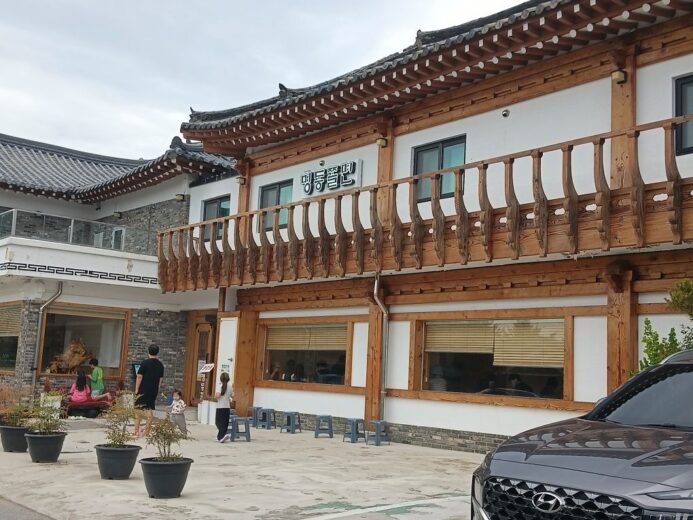
While exploring the ancient city of Gyeongju, we couldn’t help but feel that it would be the sort of place where heritage food quietly thrives. Amidst centuries of history, we found ourselves at Park Yongja Gyeongju Myeongdong Jjolmyeon, a humble establishment that has been serving its signature chewy noodles since 1977.
Park Yongja Gyeongju Myeongdong Jjolmyeon has quietly done what many restaurants aspire to achieve – earning a reputation by focusing on just a handful of dishes. Their menu consists of only four variations of Jjolmyeon. There is something reassuring about a place that chooses not to offer everything, but instead pours decades of experience into making one thing exceptionally well.
Jjolmyeon takes its name from Jjolgit (chewy) and Myeon (noodles), and true to its name, the noodles are wonderfully springy. Made with potato starch, they are slightly thicker than one might expect, closer to a thin strand of spaghetti than a typical Korean noodle. Every bite has a satisfying chew that makes the simple act of eating feel surprisingly enjoyable.
During the warmer months from May to September, the restaurant is well known for its cold Jjolmyeon. On the day of our visit, however, Gyeongju was sweltering under the summer sun. While a chilled bowl would have been the obvious choice, we had already enjoyed several bowls of Naengmyeon throughout our road trip. Somehow, a warm broth simply felt more comforting.
We ordered the Spicy Chewy Noodles with Fishcake, and it turned out to be exactly the sort of lunch we were hoping for.
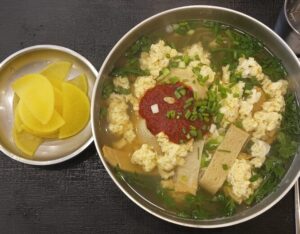
Their kind staff explained that the noodles derive their signature chew from the generous use of potato starch. The texture was wonderfully satisfying, offering just enough resistance without ever feeling tough. It was the sort of noodle you found yourself happily chewing for just a little longer, savouring its texture before reaching for the next bite.
The broth was remarkably gentle. Made from seaweed, anchovies, shrimp and sesame, it carried a clean, delicate umami that felt comforting rather than assertive. A touch of gochujang brought gentle warmth rather than fiery heat, making it the sort of broth you could happily finish to the very last spoonful.
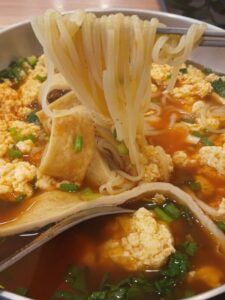
The egg was a quiet delight. Rather than ribbons, it formed soft, fluffy clouds that floated through the broth, each one gently soaking up its delicate umami. Light and almost sponge-like, they carried the flavours of anchovy, seaweed and gochujang with every spoonful. It was a humble ingredient that asked for little attention, yet somehow made the entire bowl feel warmer, fuller and wonderfully complete.
The fishcake was equally understated – tender, mildly seasoned and comforting. Fresh Minari (water celery) added a gentle crunch and a welcome brightness that lifted each mouthful. Together with the wonderfully chewy noodles, every spoonful felt balanced and deeply satisfying.
Sometimes the most memorable meals are not the richest or the most elaborate, but the ones prepared with care, where every ingredient quietly plays its part. Perhaps that is the quiet profundity of heritage food. Rather than masking its ingredients, it allows each one to express its own character, creating harmony through balance instead of excess.
Other Related Articles:
Read about Chalborippang in Gyeongju.
About Gyeongju
There is a quiet elegance about Gyeongju that sets it apart from the bustle of modern Korea. As the ancient capital of the Silla Kingdom, it is a city where history, craftsmanship and local food traditions have been carefully preserved for generations. Visit Bulguksa Temple, Gyochon Village, Donggung Palace, and Daereungwon Ancient Tomb.