
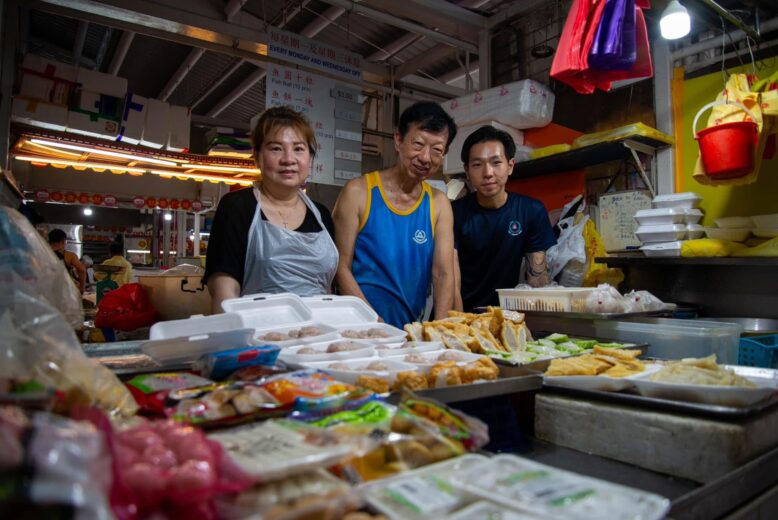
From a roadside pushcart in 1960s Singapore to a modern eatery, third-generation custodian Delonix Tan is finding new ways to keep his family’s Teochew fishball tradition alive.
A good fishball should have a little attitude. Bite into it and it should push back, just enough to give you that satisfying bounce before surrendering to the delicate sweetness of fresh fish. At San Dai Yong Tau Foo, that recipe has remained unchanged since the 1960s. What has changed considerably is the world around it, particularly how younger Singaporeans buy, cook and consume their food. For Delonix Tan, the third-generation entrepreneur behind San Dai, the challenge is not merely to preserve his grandfather’s recipe but to ensure it continues to have a place in Singapore’s evolving food culture.
The story began with Heng Kee Fishball & Yong Tau Foo, a modest roadside business established by Tan Kok Heng in the 1960s. His son, Tan Yew Seng, took over in the late 1990s, continuing to supply freshly made fishballs and yong tau foo ingredients to households and businesses.
For years, customers visited the family’s Toa Payoh stall to buy fresh fishballs and stuffed vegetables to cook at home. It was the sort of everyday routine that many Singaporean families would recognise: a trip to the market, a bag of fresh ingredients and dinner sorted. But times have changed. Younger consumers are less inclined to spend their mornings shopping for ingredients or their evenings preparing dinner. Why cook a pot of yong tau foo when you can have someone make it for you?

Delonix understood this shift when he joined the family business in September 2025. Rather than trying to convince younger Singaporeans to shop like their grandparents, he decided to bring his grandparents’ food into their world. The business was rebranded as San Dai, meaning three generations, with two modern eating outlets serving freshly prepared Teochew fishballs and yong tau foo.
It sounds like an obvious business decision, but it represents a significant change for a family whose livelihood had long revolved around producing fresh ingredients. Delonix wasn’t merely giving an old stall a new signboard. He was changing how people experienced the family’s food, while making sure the food itself remained familiar to those who had grown up eating it.
When a fishball contains nothing more than fish, water, salt and MSG, there is nowhere to hide. San Dai’s fishballs are made using 100% yellowtail fish meat, without flour or starch fillers. Their distinctive springiness comes from the natural properties of fish proteins rather than added texturisers. This makes ingredient quality, temperature control and mixing technique particularly important because there is little room to disguise mistakes.
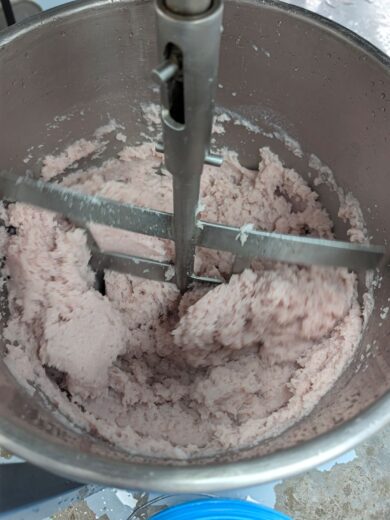
Watching San Dai’s production process, we discovered that making a good fishball involves rather more science than its humble appearance suggests. Although much of the grinding and mixing has been mechanised, the process still depends on someone knowing exactly what to look for.
Temperature is particularly important. Friction generated during mixing produces heat, while Singapore’s warm ambient conditions add another variable. If the paste becomes too warm, its proteins can lose some of their ability to form the elastic gel structure responsible for that desirable bounce. Water helps regulate temperature and consistency, while salt assists in extracting the proteins needed to bind the paste together.
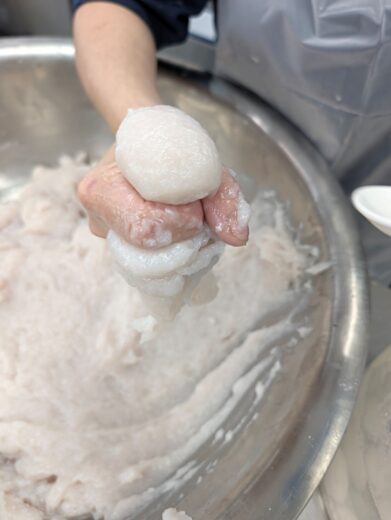
This illustrates an important distinction in traditional food craftsmanship. Mechanisation does not necessarily diminish authenticity if the essential recipe, technical knowledge and quality controls remain intact. A machine may perform the grinding and mixing, but it still takes an experienced maker to recognise when the fish paste is ready.
Now, fishballs and yong tau foo aren’t exactly the sort of food that gets people dressing up for dinner. They are everyday comfort food, the kind you might choose when you want something light, wholesome and uncomplicated – don’t mistake uncomplicated for uninteresting.
San Dai serves Teochew-style yong tau foo, which generally has a lighter character than many Hakka versions. Teochew fishballs traditionally emphasise pure fish paste, whereas Hakka-style fillings may incorporate pork. The broth is also typically gentler, allowing the ingredients to do more of the talking.
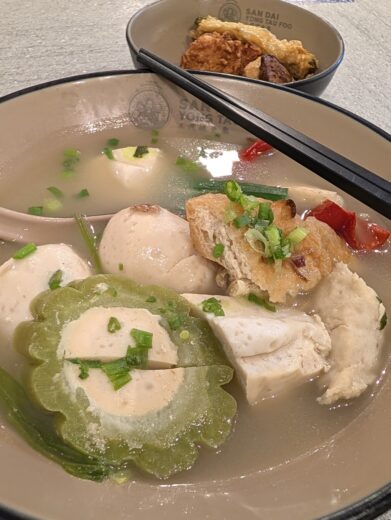
San Dai has given its soup a little extra depth by using anchovies and pork bones instead of relying on the more traditional combination of soybeans and anchovies. It is a modest adaptation, producing a clean, savoury broth that complements rather than overwhelms the fish paste.
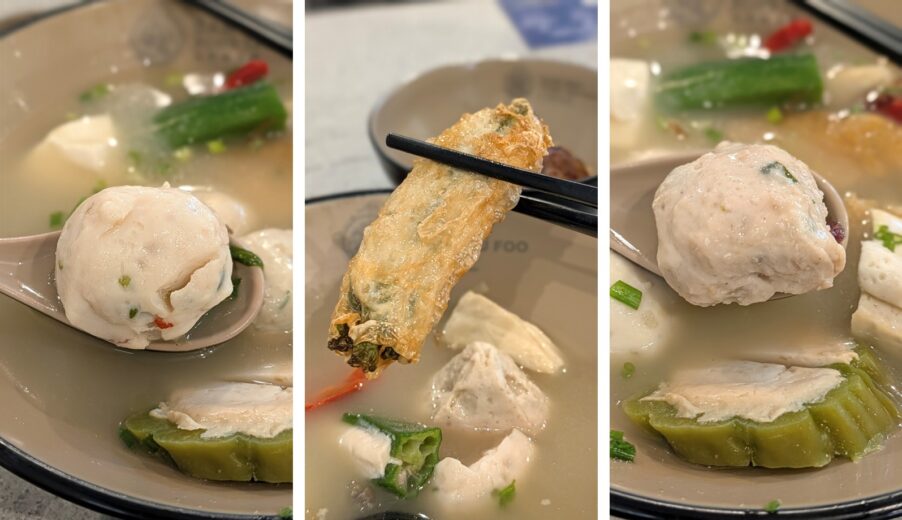
We sampled both versions of San Dai’s handmade fishballs, the original plain variety and another incorporating chilli and spring onions. The plain version is where we recommend starting, as it offers the clearest expression of the fish itself. It has a satisfying springiness and delicate flavour without excessive seasoning. The chilli and spring onion variation introduces little bursts of fragrance without masking the taste of the fish.
What impressed us equally was the quality of the yong tau foo ingredients. The stuffed vegetables and tofu are prepared fresh daily at each outlet, and there is a noticeable effort to ensure every individual ingredient is worthy of accompanying the family’s fish paste.
The white tofu was fresh, supple and fragrant with the natural aroma of soybeans. The ladies’ fingers were tender, without the stringy, fibrous texture that can turn an otherwise innocent vegetable into something resembling a piece of timber. The fried tofu was another pleasant surprise. Rather than carrying the stale-oil smell sometimes associated with fried bean curd, it was airy, light and spongy, soaking up the broth beautifully. Biting into it released a little squirt of savoury soup, followed by the softness of the tofu and finally the springy resistance of the fish paste.
Two other items deserve mention. The first was a fried creation of long beans wrapped in fish paste and encased in dried tofu skin. Fried in the same oil used for the Teochew meatballs, it picked up an additional meaty savouriness from the pork. Despite this, it was pleasantly light and not greasy, with a good contrast between the crisp exterior, tender vegetables and springy filling.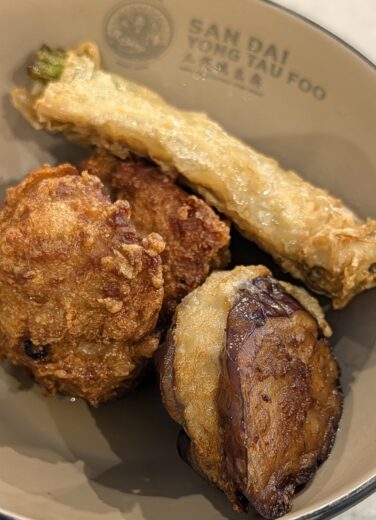
The boiled Teochew meatball provided a completely different experience. Denser, meatier and wonderfully unctuous, it was a welcome contrast to the lighter fishballs and vegetables.
By the time we had worked our way through the bowl, it felt like a little neighbourhood party. The fishballs were the lively, bouncy ones, the tofu was soft and comforting, the vegetables brought freshness, and the meatballs turned up with a little more richness. Different personalities, flavours and textures, all getting along beautifully in a light broth.
What makes a bowl like this special is that its apparent simplicity belies the craftsmanship behind it. There are no elaborate cooking techniques or complicated sauces to impress the diner. Instead, the complexity lies in how each ingredient is selected, prepared and handled to bring out its best qualities. It is a reminder that good cooking does not always require complicated recipes. Sometimes, the greatest skill lies in making something simple taste exceptionally good.
We chatted with a young customer who discovered San Dai through a friend’s recommendation and was delighted to find good-quality food that preserved traditional flavours. It was a small but encouraging endorsement, particularly because it came from someone in the very generation Delonix hopes to reach. Heritage food doesn’t necessarily need a radical makeover to appeal to younger diners.
Delonix comes across as a level-headed and thoughtful young entrepreneur. Although he is continuing a family business, his motivation is not simply filial obligation. He sees genuine entrepreneurial potential in San Dai, coupled with a personal conviction that good-quality traditional foods deserve to remain accessible to future generations.
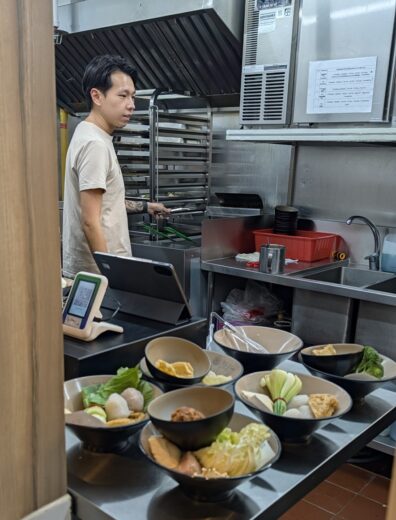
During our visit to San Dai’s Anchorvale outlet, we noticed something rather endearing about Delonix. Although he is the boss, he was certainly not above rolling up his sleeves and helping out in the kitchen. Between attending to the daily operations, he also made his way around the dining area, speaking with customers and asking about their experience. There was an earnestness and sense of urgency in the way he went about his work that we found refreshing. He wanted to know, firsthand, whether his customers were enjoying the food. For someone carrying a family legacy, that willingness to listen is just as important as knowing how to make a good fishball.
When we asked whether he intended to introduce more fish-based products, Delonix was cautious. Singapore’s challenging operating environment and high overheads make expansion expensive, and he believes the business should grow at a measured pace. More importantly, he is concerned that introducing too many products or excessive automation could compromise quality and blur the identity that the family has built over the decades.
The same reasoning applies to opening additional outlets. While rapid expansion might increase brand visibility, it also demands significant capital and creates operational pressures that could affect the food.
Delonix acknowledges that traditional food production is not necessarily a high-margin business, especially when ingredient quality and labour-intensive processes are priorities. There may be easier ways to make money in the food industry, but he believes this legacy is worth the effort.
One of the more endearing aspects of Delonix’s stewardship is his use of Teochew in San Dai’s social media content. He regularly shares the family’s history and explains the fishball-making process in the dialect, demonstrating a fluency increasingly uncommon among younger Singaporeans.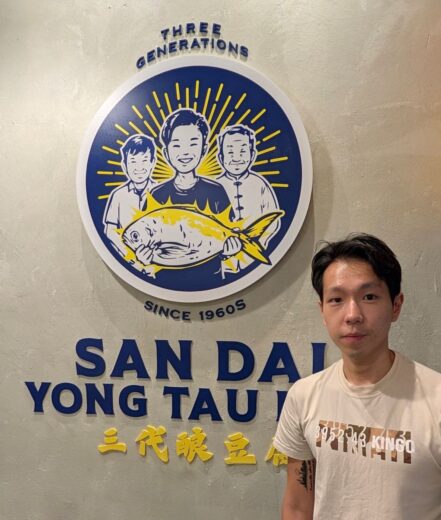
Food and language are closely connected, particularly in traditional family businesses where recipes and techniques were often passed down through conversation rather than written instructions. Certain expressions, cooking terms and cultural references carry meanings that are difficult to reproduce in another language.
Listening to Delonix speak about fishball-making in Teochew adds a dimension of authenticity to San Dai’s story. His command of the dialect reflects a genuine connection to the culture and family history behind the food. And there is something rather charming about using Instagram and social media to keep an old Chinese dialect relevant. The platform may be modern, but the voice telling the story belongs to a much older tradition.
We often romanticise heritage food businesses, imagining that preserving tradition means keeping everything exactly as it was. The same equipment, the same shopfront, perhaps even the same faded signboard. But a food business cannot survive on nostalgia alone, particularly when the customers who once supported it have changed the way they live and eat.
Delonix understands that for a heritage food business to survive, it must remain commercially viable and relevant to the people it hopes to serve. His decision to introduce modern eating outlets is not an abandonment of the past, but a way of creating new opportunities for people to experience it.
What makes San Dai interesting is that the modernisation has happened around the food rather than at its expense. The branding, dining experience and communication have evolved, but the original recipe and the knowledge behind it remain central to the business.
For The Humble Belly, this is an encouraging example of how a younger generation can approach food heritage without being trapped by the past. Delonix is not trying to recreate his grandfather’s Singapore, nor is he chasing every new food trend. Three generations of the Tan family have built their livelihood around a remarkably simple fishball. He is finding a practical way for a traditional product to remain relevant while protecting the qualities that have kept customers returning for decades.
In the end, it takes more than four ingredients to make a good fishball. It takes a humble person with a simple wish: to make good food and feed people well.