
Some meals are memorable because they are delicious. Others are memorable because they make you question every decision that led you to the table.
Established in 1963, Gyeongbuksan Eel is a trusted neighbourhood restaurant in Busan known for serving Gomjangeo (hagfish). Hagfish only became widely eaten in Korea after the Korean War, when poverty and food shortages forced people to seek affordable and abundant sources of protein. What began as a meal of necessity has today become one of Busan’s most distinctive local delicacies.
We had met our new Chinese friends only hours earlier. Somehow, by late afternoon, they had already agreed to follow along on our eating itinerary.

Whether that was bravery, blind faith, or a regrettable lack of due diligence, we’ll never know.
What we do know is that the very first dinner of our newfound friendship involved hagfish.
Most people ease into a friendship over coffee.
We skipped straight to hagfish.
If you’ve never seen a hagfish before, imagine one of the ocean’s most primitive creatures. It is a jawless, eyeless marine animal with loose skin that gives it the appearance of a sagging, boneless pink-grey worm. Its circular, tooth-lined mouth certainly doesn’t do it any favours. Living along the ocean floor as a scavenger, the hagfish is hardly what most people would picture as dinner.
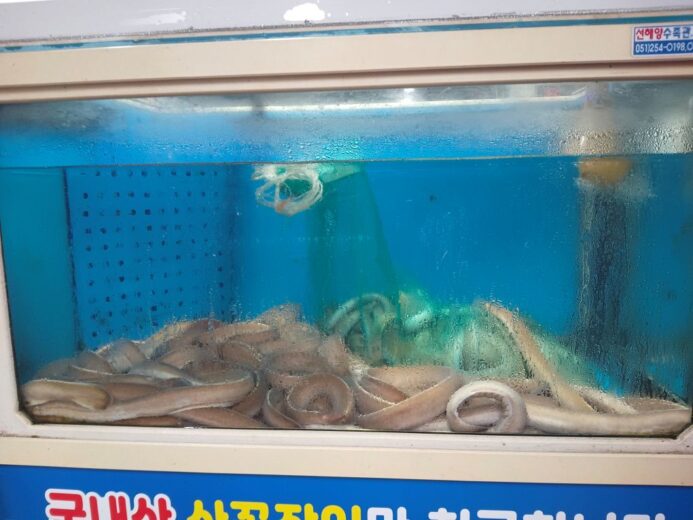
Yet generations of Koreans saw something entirely different.
What many would dismiss for its appearance, they recognised for its value. Once the loose outer skin is removed, what remains is firm, meaty flesh with a wonderfully satisfying texture. It’s another reminder that some of the world’s greatest heritage foods were never born from luxury, but from resourcefulness, resilience and a refusal to waste what nature provided.
Before long, the staff wheeled the fresh hagfish onto the grill. As first-timers, we wouldn’t have missed this moment for anything. Watching one of Korea’s most unusual delicacies being prepared was all part of the experience.
The eyeless creature continued to writhe on the hot plate, a sight that would undoubtedly make the squeamish think twice. In reality, what we were witnessing were simply residual nerve reflexes after death, but science only goes so far when your eyes are telling you otherwise.
For us, however, it only heightened the anticipation. We couldn’t wait to find out why generations of Busan locals had continued to enjoy this humble creature for decades.
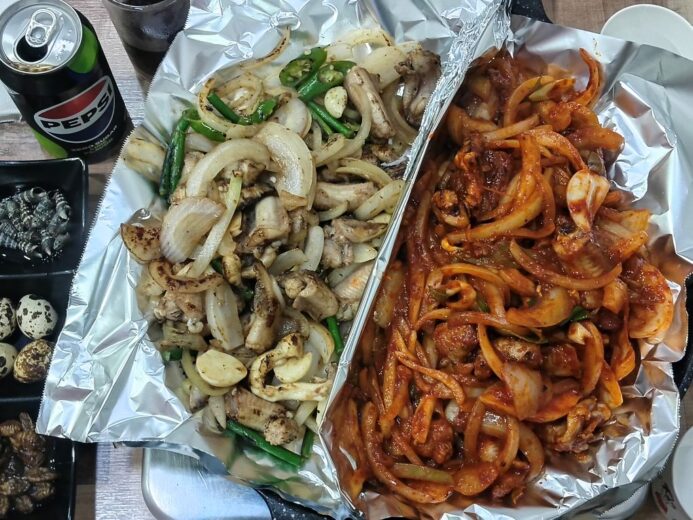
In Korea, hagfish is commonly prepared two ways: Sogeum-gui (salt grilled) and Yangnyeom-gui (spicy stir-fried). We were fortunate enough to try both.
The spicy version arrived coated generously with garlic, onions and fiery yangnyeom sauce. Hagfish doesn’t possess the rich flavour of freshwater eel, making it an ideal canvas for bold Korean seasonings. Smoky, savoury, sweet and spicy, it was unapologetically flavourful.
Surprisingly, it was the salt-grilled version that won us over.
The gentle smokiness paired beautifully with the hagfish’s natural brininess. Every bite tasted clean, fresh and distinctly of the sea. Combined with its wonderfully firm, crunchy texture, it was surprisingly addictive. We found ourselves reaching for piece after piece, especially when wrapped in fragrant perilla leaves. The herbal, woody, slightly anise-like aroma complemented the hagfish so naturally that it quickly became our favourite way to enjoy it. Experiencing both preparations side by side was fascinating—one celebrated bold Korean flavours, while the other quietly allowed the ingredient to shine.
The biggest surprise, however, was the texture.
Despite its eel-like appearance, hagfish is nothing like eel. It is remarkably firm, crunchy and satisfyingly chewy, making it the perfect companion to a cold beer or a glass of soju. It is easy to understand why this has remained a favourite anju for generations.
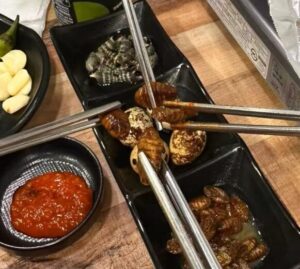
Just when we thought the evening couldn’t become any more adventurous, another banchan arrived.
Beondegi.
Silkworm pupae.
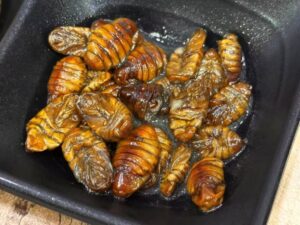
Up until this point, every banchan we had encountered in Korea had felt comfortably familiar. Hard-boiled quail eggs? Absolutely. But a bowl of silkworm pupae seemed determined to live up to the adventurous reputation of the hagfish.
True to our Humble Belly fellowship, each of us picked up a silkworm, raised it for a toast, exchanged a few nervous smiles… and committed.
The shell offered a slight crunch before the inside… well… squirted.
Its earthy, woody flavour wasn’t unpleasant at all. Was it delicious? Not particularly. Would we order it again? Probably not – not when there was perfectly good hagfish sitting in front of us.
One of the reasons The Humble Belly exists is to help people look beyond appearances, cultural stereotypes, and unfamiliar ingredients. Every heritage food carries a story, and every story deserves to be understood before it is judged.
That evening, the hagfish reminded us that the strangest-looking foods often hide wonderful traditions, and sometimes the most unlikely meals become the beginning of meaningful friendships.
Looking back, perhaps hagfish was the perfect first dinner after all.
If a friendship can survive hagfish and silkworms on day one, it can probably survive just about anything.