
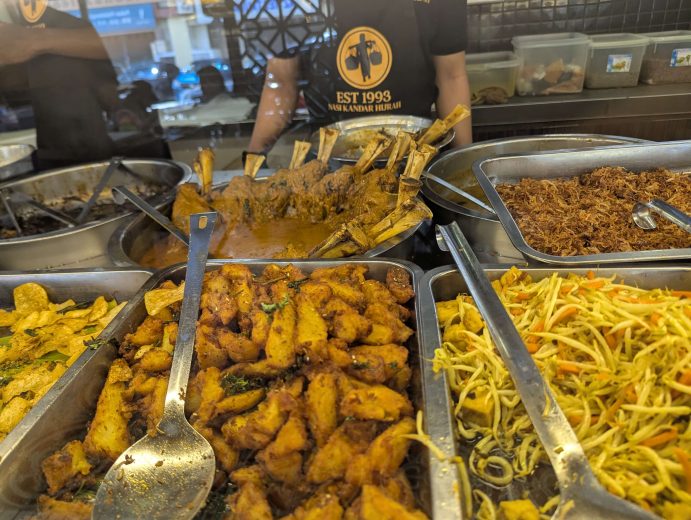
Tucked within the steady bustle of Nasi Kandar Hijrah in Taman Molek is a place that quietly bridges time. Step inside today and you’ll find a space that has evolved into something casual and comfortable, a far cry from the no-frills nasi kandar joints of old, yet without losing the soul that made it worth modernising in the first place.
Since 1993, this Indian Muslim establishment has been doing what many try but few sustain—serving food that feels rooted in the past, yet effortlessly relevant in the present.
At its core, this is still very much an old-school nasi kandar experience—just one that has learned a few new tricks. The rhythm is familiar: trays upon trays of dishes lined up, each one vying for your attention. The only problem? There are over 30 of them.
Decision paralysis is real here. But that’s part of the charm.
The queue builds quickly, especially during peak breakfast and lunch hours. Yet, like any well-oiled nasi kandar operation, it moves at a respectable pace. The bottleneck isn’t the staff—it’s you. Or rather, people like you, staring blankly at the spread, trying to rationalise how many dishes can realistically fit onto one plate. The answer, of course, is always “just one more.”
Start with the rice—white, turmeric-stained kuning, or briyani. Each serves as a canvas, but it’s what you pile on top that defines the experience.
The Ayam Goreng Berempah is a standard crowd pleaser. Golden-brown and unapologetically aromatic, it arrives with a crust that crackles just enough before giving way to juicy, well-seasoned meat. This is not a polite piece of fried chicken. It’s what a decent piece of fried chicken should be, spiced and not over salted, and immensely satisfying. Go for the thigh or drumstick—this is not the time for restraint.
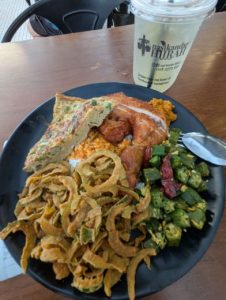
Equally impressive is the Telur Dadah, an egg dish so simple it often gets taken for granted. But not here. The omelette is light, fluffy, and fragrant, with none of the oiliness that plagues lesser versions. It’s cooked just right—soft and slightly airy on the inside—and acts as a perfect sponge for the array of curry gravies. In many ways, it’s the quiet hero of the plate, tying everything together without demanding attention.
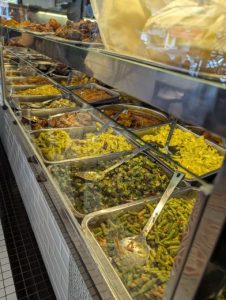
Each vegetable retains its integrity, cooked to the right doneness, seasoned thoughtfully, and served with a kind of respect that’s rare in a nasi kandar spread.
It’s hearty food, but it doesn’t feel heavy-handed.
The curries themselves strike a careful balance. They’re aromatic and layered, but not overwhelmingly rich. There’s enough depth to feel indulgent, yet restrained enough to keep you going back for more without fatigue. It’s this balance that makes the food so “moorish”—you think you’re done, and then you find yourself reaching for another bite.
And then there’s the sambal.
Blended with coconut, it carries a nutty, almost toasty profile that sets it apart from the usual fiery condiments. There’s a good kick of spice, but it’s not just about heat—it’s about dimension. When paired with the curries, the sambal acts as an amplifier, lifting the entire plate without overwhelming it.
For those looking to indulge a little further, the lamb shank is worth a try. It’s fall-off-the-bone tender, richly cooked, and deeply satisfying. That said, it does carry a slightly gamey note, which may not be for everyone. But for those who appreciate the character of lamb in its full expression, it’s a rewarding dish.
What makes Nasi Kandar Hijrah special isn’t just the food—it’s the way everything comes together. The old-school recipes, the modern setting, the variety, the execution. It’s a place that understands its roots but isn’t stuck in them.