
63 Years of Nasi Lemak Wanjo in Kampung Baru
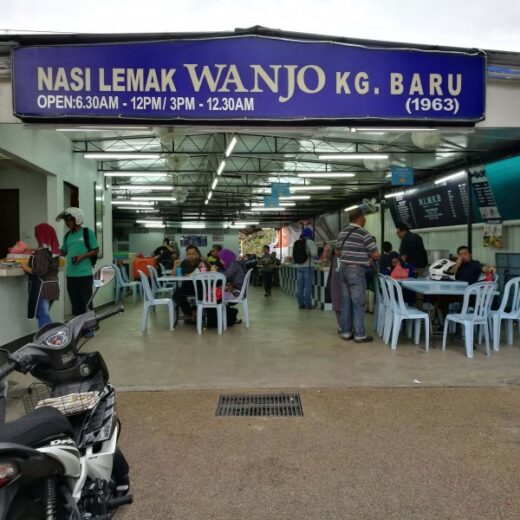
When Nasi Lemak Wanjo first started in 1963, Kampung Baru was a very different place – a quiet Malay village sitting just beyond what would eventually become the modern heart of Kuala Lumpur.
Even when we first visited over a decade ago, this stretch felt considerably sleepier. There were only a handful of eateries along a simple tar road, and Wanjo still felt very much like a neighbourhood nasi lemak shop patronised by locals.
Return in 2026 and the street is almost unrecognisable. The road is beautifully paved, vibrant eateries line both sides and the area has become a popular destination for locals and tourists seeking Malay food.
Walk down the street from Wanjo and Kuala Lumpur’s skyline appears in the distance, with the Petronas Twin Towers rising above Kampung Baru. It is a striking contrast between modern Kuala Lumpur and a neighbourhood that has held onto much of its Malay identity.
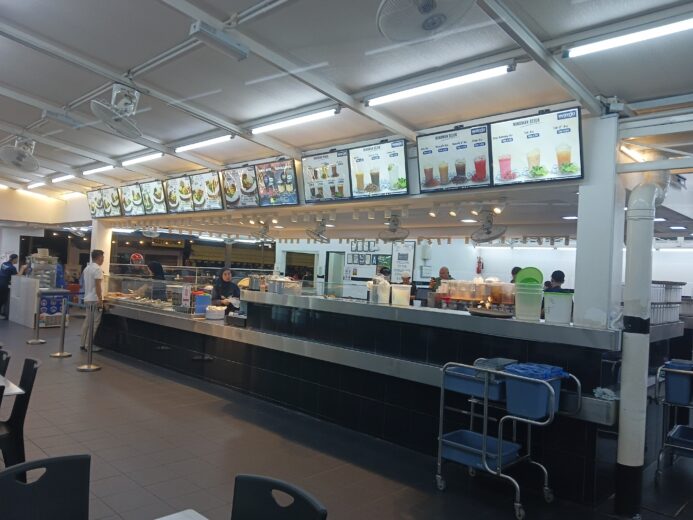
Wanjo has had a front-row seat to that transformation for 63 years. It has grown too – larger, busier and considerably more polished than the establishment we remember. But thankfully, nobody seems to have told the kitchen that heritage food needs reinventing. There is no fancy reinterpretation of nasi lemak here. Wanjo has moved with the times without becoming overly clever with the food that made people come in the first place. And perhaps that is why people are still coming.
A Dish Older Than Anyone Can Remember
For something so deeply associated with Malaysia, the exact origins of nasi lemak are surprisingly difficult to pin down. There is no definitive record of who invented it or precisely when Malays began eating it. Written references stretch back to the 19th century, while its origins are generally associated with coastal communities of the Malay Peninsula, where coconuts and seafood were readily available.
There is even an old piece of folklore about a young Malaccan girl accidentally spilling coconut milk into a pot of rice. Whether that actually resulted in the birth of nasi lemak is impossible to know, but it makes for a charming story.
In Malay, lemak describes richness or fattiness. In nasi lemak, that richness comes from santan (coconut milk) used to cook the rice together with pandan leaves and aromatics.
Its coastal roots can also be seen in one of its most familiar accompaniments: ikan bilis, little anchovies fried until crisp. Together with roasted peanuts, cucumber, egg and sambal, these form what most Malaysians would recognise as a basic plate of nasi lemak.
Beyond that, there are few hard-and-fast rules. Over generations, nasi lemak has evolved across Malaysia, with different states and vendors developing their own combinations of sambal and lauk (dishes).
What Makes a Good Nasi Lemak?
For us, it begins with the rice.
Good nasi lemak rice should be fragrant and sufficiently rich with coconut milk. The grains should be plump, glossy and fluffy while remaining individually defined rather than clumping together. Pandan provides its distinctive aroma while santan gives the rice the richness that earns the dish its name. With rising ingredient costs, this is also where cutting corners becomes obvious. Without enough santan, nasi lemak rather quickly loses the lemak.
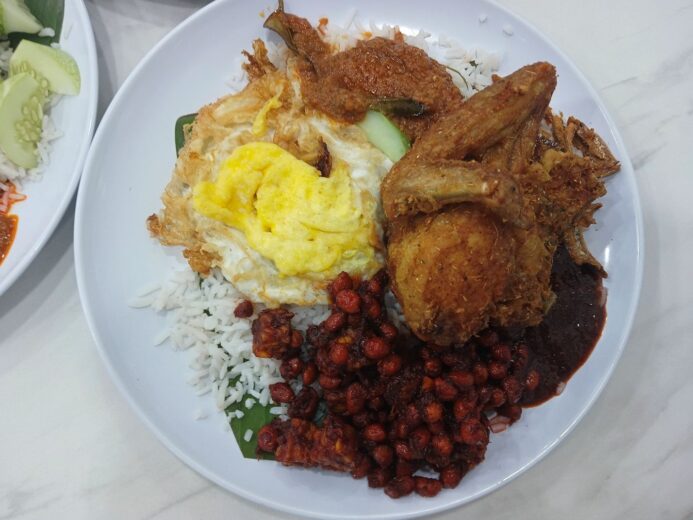
The ikan bilis should be fried golden and crisp without becoming teeth-testing hard or overwhelmingly fishy. The peanuts should taste freshly roasted and remain crisp rather than stale or soft.
Get these simple things right and even without a mountain of lauk, you already have a satisfying plate.
Wanjo’s Nasi Lemak
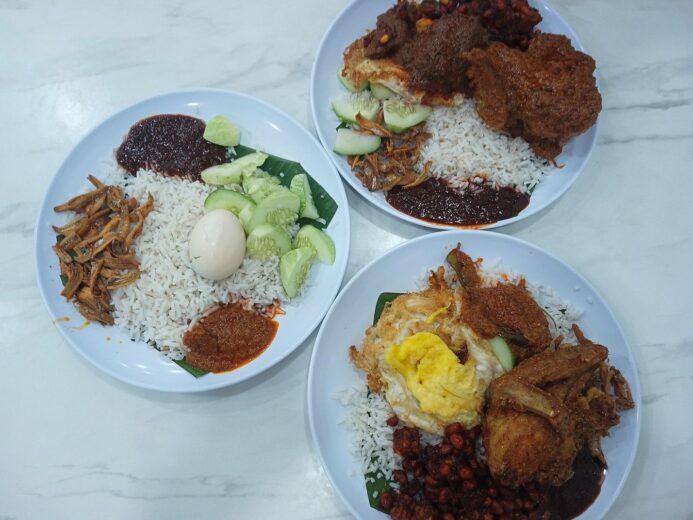
At Wanjo, the basic nasi lemak remains a very good representation of this Malaysian classic. The rice carries the familiar coconut fragrance and richness we look for, accompanied by the essential ikan bilis, peanuts, cucumber, egg and sambal. Nothing feels like it is trying to reinvent what nasi lemak should be.
Of course, standing in front of Wanjo’s selection of lauk and ordering only the basics requires considerably more restraint than we possess. So we added beef rendang, chicken rendang, fried chicken and fried tempeh.
Both rendangs were fork-tender, carrying the creamy richness of coconut together with the nuttiness of kerisik (toasted grated coconut). The spices were aromatic without overwhelming the meat, with a mild sweetness balancing the heat and savoury flavours.
Don’t Overlook the Tempeh
One of the quieter pleasures on our plate was the fried tempeh.
Tempeh is a fermented soybean cake and one of those deceptively simple foods that can be wonderful when handled properly and considerably less exciting when it isn’t.
There wasn’t an overpowering fermented flavour. Instead, the tempeh was stir-fried with toasted peanuts and little caramelised pieces of aromatics. Shallot, lemongrass and chilli brought fragrance and gentle heat, with mildly charred bits clinging to the tempeh beneath a sweet and lightly fiery coating.
Eat a little with the coconut rice and suddenly there is another layer – nutty, sweet, spicy and aromatic, with different textures in every mouthful.
As for the fried chicken, admittedly, it wasn’t the best version we’ve eaten in Malaysia. But after 63 years, Wanjo has enough going for it that we’re not going to spend the rest of this story picking a fight with a chicken.
Still Wanjo

Wanjo is no longer the little neighbourhood eatery it once was. Generations have eaten here, its reputation has travelled far beyond Kampung Baru, and visitors now seek it out as one of Kuala Lumpur’s familiar nasi lemak names.
Yet success has not persuaded Wanjo to become something it isn’t. Heritage food does not always need to be reinvented, elevated or dressed up for a new generation. It is good simple food that has kept people coming back since 1963.
Related Article:
Nasi Lemak in Johor Bahru – https://humblebelly.com/humble-mentions/nasi-lemak-hantu-baru/