
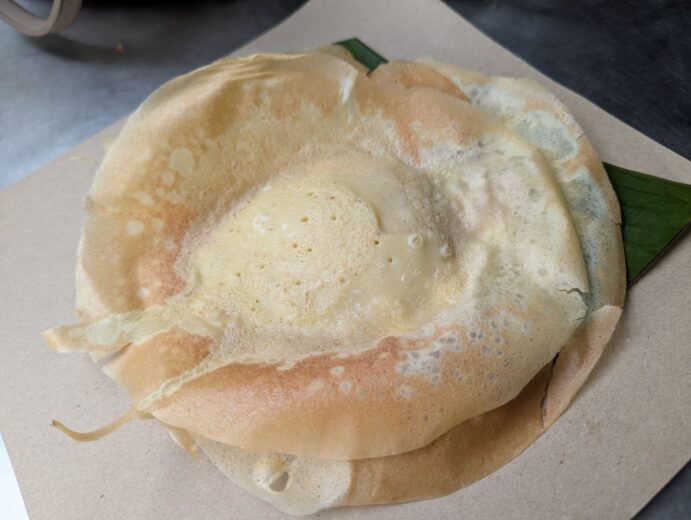
Some foods require patience. Sai Ram’s Apom Manis requires patience, discipline and the ability to stop staring at everybody else’s order.
Apom Manis is Penang’s sweet adaptation of the South Indian appam: a delicate pancake with wafer-thin edges and a soft, almost pillowy centre. In Penang, generations of hawkers have made the dish their own, and Sai Ram has been at it since 1974.
The story began with the family’s first-generation patriarch, formerly a hospital cook, who started selling apom after retirement. Today, the business has reached its third generation. The little pushcart along Lorong Kuching in Pulau Tikus doesn’t look particularly complicated – until you watch the process.
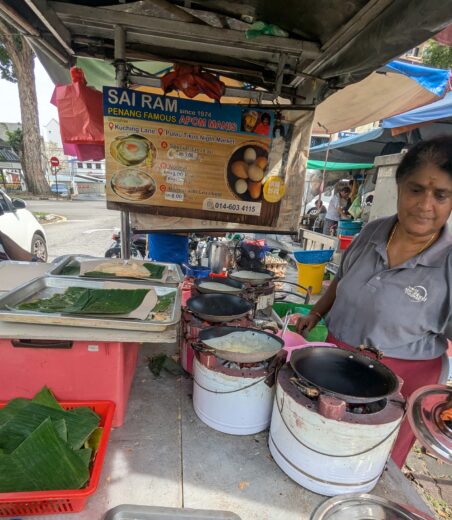
Then you wait. And wait.
This becomes considerably more painful when the person ahead of you has ordered twenty pieces. Or thirty. Heaven forbid, a hundred.
Don’t count them. Seriously.
Standing beside the cart mentally subtracting every apom that isn’t yours is a particularly cruel form of self-inflicted torture. The aroma of coconut and egg floats through the air while perfectly golden pancakes disappear into someone else’s packet.
Five pans. Five apom at a time. There is nowhere for technology to intervene, and frankly, it shouldn’t.
Crispy, fluffy and dangerously light
A good apom manis gives you the best of both worlds – wafer-thin, crispy edges and a soft, fluffy centre.
Sai Ram gets that transition beautifully.
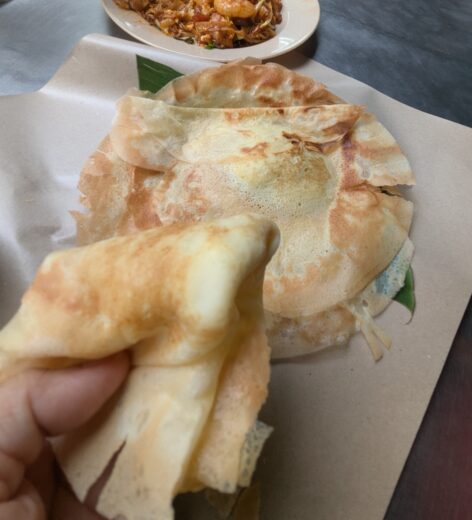
Too much sugar can easily compensate for weak coconut flavour. Too much heat can turn delicate caramelisation into burnt bitterness. Here, the apom arrives beautifully golden, cooked patiently over charcoal – a method the family has deliberately maintained even as many sellers moved to gas.
And these should be eaten hot.
Not after your shopping. Not back at the hotel. Now.
Roll it. Fold it. Tear it apart. There is no apom police.
Egg on an apom? Absolutely.
Sai Ram also makes a savoury-leaning version with an extra egg cooked in the centre. Add a little soy sauce and white pepper and suddenly the experience becomes strangely familiar.
Think of the pleasure of kaya toast dipped into soft-boiled eggs with soy sauce and pepper – except someone has conveniently engineered the egg and pancake into one edible package.
Breakfast efficiency, Penang style.
And yes, we firmly believe apom manis qualifies as an after-breakfast dessert. You have already travelled to Penang and eaten an irresponsibly large breakfast. This is hardly the moment to start making sensible decisions.
Our mistake was ordering only one set. We had already eaten heavily and told ourselves five pieces would be enough “just to taste.”
Amateurs.
They were so light that the first set disappeared with suspicious speed. We looked at the empty paper, looked back at the queue, and realised the terrible consequence of our restraint: We had to wait all over again.
After more than five decades, Sai Ram still makes its apom five pans at a time, over charcoal, on a humble roadside pushcart.
Perhaps that’s the lesson here.
Some traditions aren’t supposed to become more efficient.
Just remember to order enough the first time.