
There is something about sitting on a plastic chair, in the open air, at a street corner, that makes food taste more honest.
At Sate Salleh in Johor Bahru, the experience begins before the first bite. It lives in the air—thin ribbons of charcoal smoke curling upwards, carrying with them the sweet, spiced perfume of turmeric and lemongrass. Every so often, a breeze passes through, just enough to stir the smoke and brush it gently across your face, as though reminding you: this is not just dinner, this is ritual.
Founded in 1957, Sate Salleh belongs to a lineage far older than itself. Satay, beloved across Southeast Asia—from Malaysia to Indonesia, Thailand to Brunei—traces its roots back to the spice trade of the 1800s. It is said to have been inspired by Middle Eastern kebabs, brought by traders and gradually transformed by local hands. Over time, it took on a distinct identity: skewered on bamboo, cut into bite-sized portions, marinated in a chorus of regional spices.
In those early days, meat was a luxury. Cutting it into small pieces made it more accessible, more shareable. The skewers made it portable. Hawkers once carried entire satay setups balanced across their shoulders—one end a charcoal stove, the other a trove of marinated meat, peanut sauce, and condiments. It was street food in its purest form: humble, mobile, and deeply human.
When Javanese immigrants brought satay to Malaysia in the early 1900s, they infused it with local flavours—galangal, turmeric, lemongrass—laying the foundation for what we now recognise. Kajang in Malaysia would go on to become synonymous with satay, but places like Sate Salleh remind us that its soul lives in quieter corners too.
Satay, perhaps more than most dishes, ignores social boundaries. It belongs to everyone. You’ll find it at roadside stalls and wedding feasts, late-night suppers and hotel buffets, even plated neatly in business class cabins.
In Malaysia, its variations reflect the country itself—Malay vendors serving chicken, beef, and mutton; Chinese hawkers offering pork belly, liver, and intestines; each with their own interpretation of the ever-important peanut sauce.
And then there is Sate Salleh. Here, the craft lies in the fire.
Small skewers are unforgiving. A moment too long over charcoal and the meat dries; too little, and it lacks character. What Sate Salleh has mastered over decades is control—the quiet, intuitive understanding of heat. Each skewer emerges with a delicate balance: lightly charred edges that whisper smokiness, meat that remains tender and juicy within.

There is a particular flavour that comes from this style of grilling—something deeper than typical barbecue. Perhaps it is the sweetness of the marinade, where lemongrass and turmeric caramelise ever so slightly against the flame. Perhaps it is the fat, rendered just enough to coat the meat without overwhelming it. Whatever it is, it lingers.
Every skewer carries the right ratio of meat to fat. The fat, crucially, is never left unrendered—no unpleasant chew, no resistance. The right side that satisfies without being over-indulgent. The meat slides off the stick with ease, a small but telling detail.
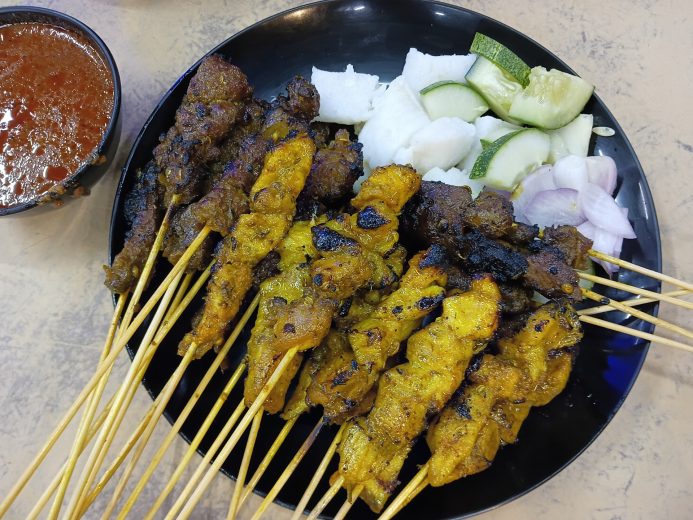
The chicken is light, almost restrained. It doesn’t try too hard, and that is precisely its charm. You taste the chicken itself, not just the marinade—a rarity in a landscape where seasoning often overwhelms. The beef is the standout—tender, well-seasoned, deeply satisfying without being heavy. It feels considered. The mutton, as expected, leans drier. It is, after all, a less forgiving protein. But here, it avoids the one thing that turns many away: excessive gaminess. What you get instead is a clean, honest flavour, with a firmer bite that some will appreciate.
What ties it all together is how easy it is to keep eating. The satay isn’t greasy. There is no heaviness weighing you down, no need to pause. One skewer becomes three, becomes ten.
On the side, the usual companions: onions, cucumbers, and ketupat. The ketupat here is softer, looser than ideal. One might prefer a denser version—something that holds its shape better after a generous dip in sauce. But even this feels like part of the charm rather than a flaw.
And the sauce—perhaps the most surprising element.
Many gravitate towards a thick, chunky peanut sauce, heavy with crushed nuts, almost gravy-like in its richness. Sate Salleh takes a different path. Their version is lighter, more balanced. The peanut fragrance is present, but it does not dominate. Instead, it shares the stage with savoury notes of shallots, garlic, and lemongrass. It is less about indulgence, more about harmony.
Satay is, at its heart, a dish meant to be shared. It gathers people—friends leaning in over conversation, families spanning generations, co-workers unwinding at the end of a long day. There is something inherently communal about it, the way skewers are passed around, counted loosely, never quite belonging to just one person.
It is not a dish that lends itself to haste. The grilling takes time, each skewer turned patiently over charcoal, and in turn, it invites you to slow down as you eat. You don’t rush satay—you sit with it, linger between bites, let conversation stretch.
In that unhurried rhythm, satay offers something more than flavour. It becomes a quiet connection to the past, to a kind of simplicity that feels increasingly rare—where food is not just consumed, but shared, savoured, and remembered.
At Sate Salleh, it is exactly this unrushed rhythm (with a very good piece of grilled skewer) that cannot be replicated in modern kitchens.