
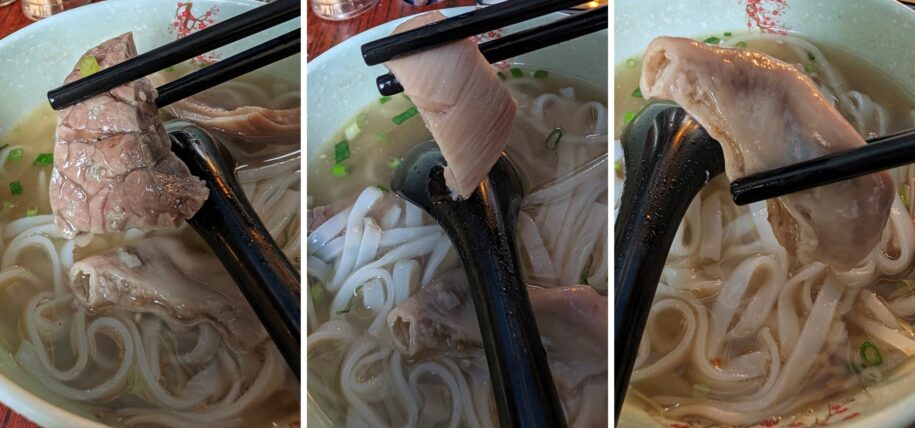
Hidden in a narrow alley in Central Hong Kong, Shui Kee serves beef brisket and offal noodles so good that even a full stomach is no excuse to walk away.
A Little Alleyway, A Big Temptation
There is something particularly dangerous about exploring Hong Kong’s food scene on a full stomach. Just when you think you have eaten enough for the day, another culinary temptation appears, and suddenly your stomach is expected to negotiate an extension.
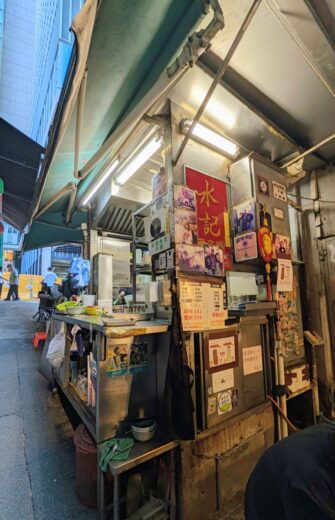
That was precisely how we stumbled upon Shui Kee (水記), an unassuming street stall tucked away in a narrow alleyway in Central Hong Kong. Without a keen eye or prior knowledge of its existence, you could easily walk past without realising that something rather special was simmering just a few steps away.
We had just finished visiting another heritage establishment when we spotted a curious sight across the street: a cluster of people sitting along a narrow alley, hunched over bowls of something that clearly commanded their attention. Naturally, our curiosity got the better of us. We made our way to the nearest pedestrian crossing, navigated around a construction site and climbed towards the alley to investigate.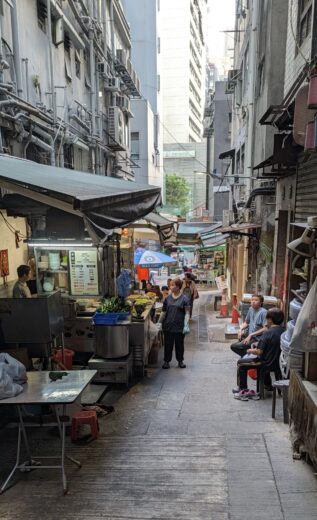
Rather than immediately committing ourselves, we decided to conduct a little reconnaissance. We walked past the stall, inspected the offerings and lingered nearby like birds circling their next meal. The problem was that we were already quite stuffed, and whatever we ate next would have to be exceptionally good to justify the precious remaining space in our humble bellies.
Then came the aroma. A gentle, beefy fragrance drifted from a bubbling pot, pleasantly savoury without the heavy, sometimes unpleasant smell associated with poorly prepared offal. It was the sort of aroma that suggested someone knew exactly what they were doing.
We struck up a conversation with a friendly young chap, whom we later discovered was the proprietor’s grandson. Between his warm hospitality, the bubbling cauldron of beef brisket and offal, and the fragrant steam rising into the alley, our resistance began to crumble. It seemed our stomachs would simply have to make room for one more bowl.
The Man Behind the Cleaver
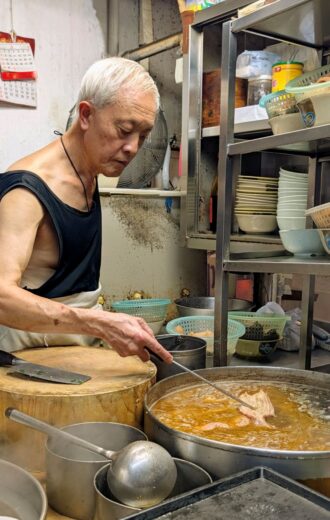
We politely requested a small bowl, which apparently was not how things worked at Shui Kee. Mr Lam took mild offence at the suggestion, firmly informing us that there was only one serving size and that we would be making a mistake by ordering anything less. We explained that we were already terribly full and simply did not want to waste his good food. We even offered to pay the full price for a smaller portion. Thankfully, our reasoning appealed to his better nature, and he eventually relented.
With a few skilful movements, he assembled a lovely bowl of mixed beef offal and flat rice noodles. What arrived looked almost deceptively modest: pale, silky noodles, beautifully prepared offal and a remarkably clear broth. There were no dramatic colours, thick sauces or elaborate garnishes competing for attention. Just a bowl of food that seemed perfectly comfortable being itself. And what a bowl it turned out to be!
Colour Is Flavour? Not at Shui Kee!
We often hear celebrity chefs on television proclaiming, “Colour is flavour!” Well, clearly nobody told Mr Lam. At Shui Kee, the broth is so remarkably clear that one might wonder where all the flavour has gone. But one spoonful is enough to prove that appearances can be deceiving. Beneath that almost translucent surface lies a beautiful depth of beefy sweetness, delicate savouriness and the gentle fragrance of fried garlic. Whoever said flavour needed colour clearly hasn’t tried Shui Kee.
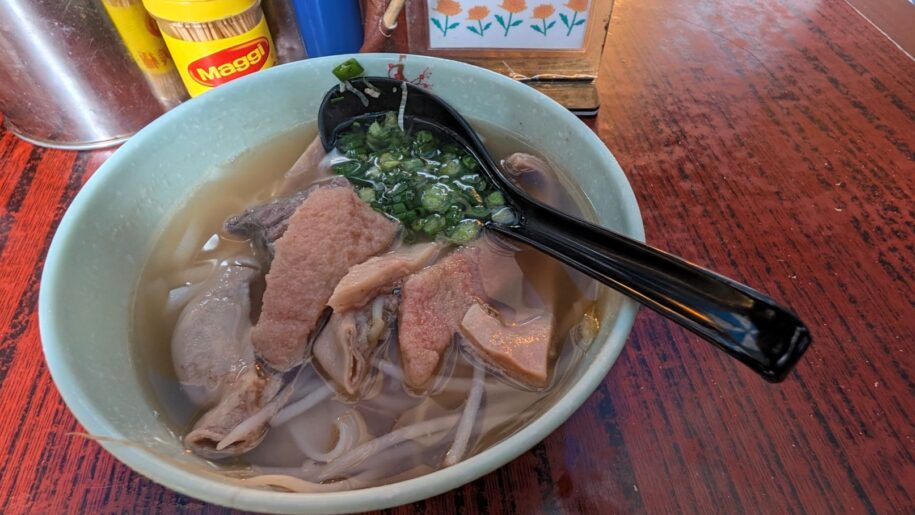
The offal was equally impressive. Each piece was tender, with a delicate, almost milky quality to its texture. There was enough natural character to distinguish the different cuts, yet nothing remotely funky or unpleasant. The flavours were clean, allowing the subtle sweetness of the beef and the carefully developed broth to take centre stage.
The flat rice noodles were beautifully silky, slipping down our throats with almost indecent ease. A mouthful of noodles, a tender piece of offal and a spoonful of that fragrant broth made for a wonderfully comforting rhythm. Before long, we had forgotten all about our supposedly full stomachs. Apparently, our humble bellies had discovered some previously unaccounted-for storage capacity.
What made the experience particularly memorable was its simplicity. There was no heavy marinade, thick braising sauce or elaborate seasoning to disguise the ingredients. Everything was presented in its most honest form, with the quality of the preparation laid bare. When there is nowhere for imperfections to hide, good craftsmanship becomes all the more apparent.
When Time Becomes the Greatest Seasoning
The secret behind Shui Kee’s remarkably clean flavours begins long before the first customer arrives. Fresh beef and offal are delivered daily, with cleaning and preparation beginning as early as 6am. It is painstaking work, particularly when dealing with the various parts of a cow’s digestive system. Every piece must be thoroughly cleaned to remove unwanted odours while preserving the textures and flavours that make offal so enjoyable.
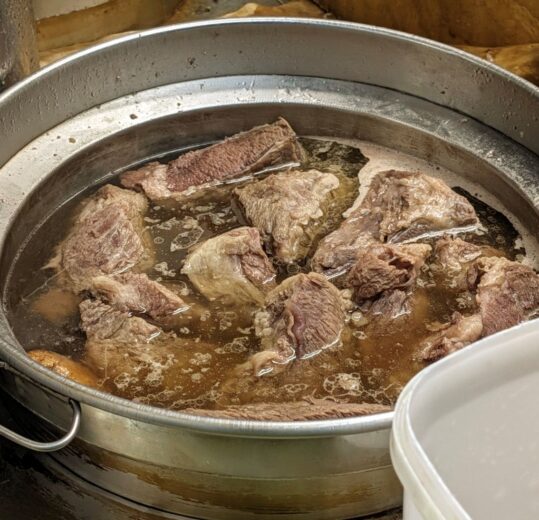
Judging by what we tasted, Shui Kee takes this responsibility very seriously. After all, poorly cleaned offal would not only ruin a bowl of noodles; it would probably make Shui Kee rather unpopular with its neighbouring shopkeepers in that narrow alley. One can only imagine the complaints if the morning air were perfumed with anything less agreeable than the gentle aroma of simmering beef.
Equally fascinating is the way its broth is maintained – fresh water is added to the previous day’s broth, along with new batches of beef and offal. This continuous replenishment allows flavours to develop over time, creating a depth that cannot simply be rushed into existence with a few extra spoonfuls of seasoning.
There is something rather poetic about this approach. While many modern kitchens pursue flavour through increasingly elaborate techniques and ingredients, Shui Kee relies on meticulous preparation, repetition and patience. Here, time is not merely a measure of how long something has been cooking. It is part of the recipe.
We subsequently learned from another veteran beef brisket maker that Shui Kee enjoys a reputation as one of Hong Kong’s finest. After our experience, we could certainly understand why.
Back for Seconds, And Something Rather Special
Some meals are enjoyable while you are eating them. Others have a habit of following you around long after the bowl has been emptied. Shui Kee belonged firmly to the latter category.
Despite the many heritage establishments on our Hong Kong itinerary, we found ourselves repeatedly thinking about that wonderfully clear broth and those tender pieces of offal. Eventually, we surrendered to temptation and returned for a second visit before leaving the city. Clearly, there was unfinished business in that little alleyway.
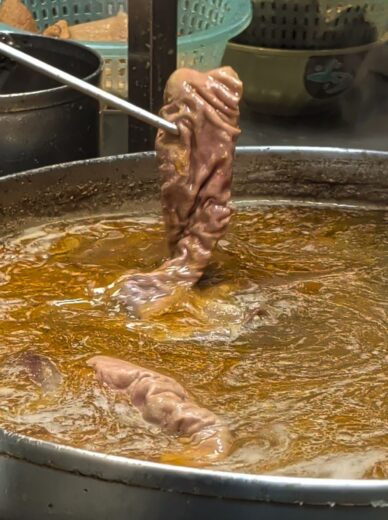
And what a delightful discovery it was! The texture was wonderfully tender, with a gentle, yielding bite reminiscent of well-prepared pig’s stomach. It had a delicate, almost creamy quality without being mushy, and its mild flavour absorbed the subtle sweetness of the broth beautifully. It was precisely the sort of ingredient that rewards an adventurous palate and reminds us why traditional offal cookery deserves far more appreciation than it often receives.
Our second bowl was every bit as enjoyable as the first, confirming that our initial encounter had been no lucky accident. More importantly, it gave us another opportunity to appreciate the quiet craftsmanship behind something that, at first glance, looked like such a simple bowl of noodles.
A Third Bowl Will Have to Wait
As we prepared to leave, Mr Lam’s grandson asked us in Cantonese whether we would be returning for a third visit before departing Hong Kong. We would have loved to say yes. Unfortunately, our remaining schedule was already packed with visits to other heritage establishments, and even the most enthusiastic stomach has its logistical limitations.
What makes Shui Kee so endearing is not merely the quality of its food, although that alone would justify a visit. It is the combination of generations of accumulated knowledge, the discipline of preparing ingredients properly and the unmistakable personality of the man behind the stove. Mr Lam does not appear particularly interested in culinary theatrics. His kitchen is a humble stove in an alleyway, his uniform a black singlet and white apron, and his greatest advertisement is the irresistible aroma rising from his pot. Yet in that modest setting, he produces a bowl of noodles with a refinement that many considerably more elaborate kitchens would struggle to match.
We arrived by accident, negotiated for a smaller portion and ended up returning for seconds. Not bad for a little stall we nearly walked past.
And to Mr Lam and his grandson, should you be reading this: we are sorry we could not make it back for a third bowl. But the next time we are in Hong Kong, we know exactly which alleyway we will be heading towards.
And we promise not to argue too much about the portion size.