
This article is the first of a 2-part series on Yue Wo Hop Kee.
From hand-tied sausages to goose liver, mala and even lap cheong gelato, third-generation custodian Sam Fu is finding new ways to preserve a traditional Cantonese craft without leaving its roots behind.
A Taste of Winter, A Tradition Worth Preserving
Long before refrigeration became part of everyday life, preserving meat was an essential means of ensuring that families had sufficient food through the colder months. In China, the practice of curing and stuffing meat into casings can be traced through written records dating back to AD 544. Over the centuries, these preservation techniques evolved into numerous regional specialities, including the familiar Cantonese lap cheong (臘腸).
The sweet, savoury and wonderfully aromatic Chinese sausage that many of us recognise today developed into its familiar Cantonese form around the 19th century. Traditionally prepared during the cooler months, lap cheong became closely associated with winter dining and Chinese New Year, when preserved meats were served as part of festive family meals.
Despite its name sometimes being translated as Chinese waxed sausage, there is no actual wax involved. The term refers to a tradition of curing and drying meat, producing sausages with a concentrated flavour, firm texture and distinctive fragrance. With its generous fat content and rich seasoning, lap cheong was traditionally considered better suited to colder weather, when hearty, warming dishes were particularly welcome.
For generations of Chinese families, a few slices of lap cheong nestled among freshly steamed rice were enough to transform a simple meal into something memorable. Yet, like many traditional foods, lap cheong has gradually lost some of its everyday relevance as dietary preferences, lifestyles and eating habits have changed.
In Hong Kong, the preservation of this culinary tradition has become increasingly important. The city’s lap mei (臘味), or preserved-meat-making craft, was included in Hong Kong’s Intangible Cultural Heritage Inventory in 2014. During the 1950s and 1960s, approximately 20 preserved-meat shops operated in Hong Kong, many with their own production facilities. Today, much of the industry has relocated to mainland China, leaving relatively few traditional producers maintaining local production.
Among them is Yue Wo Hop Kee (裕和合記), a family business established in 1973 by Fang Yinfen, a native of Dongguan, Guangdong Province.
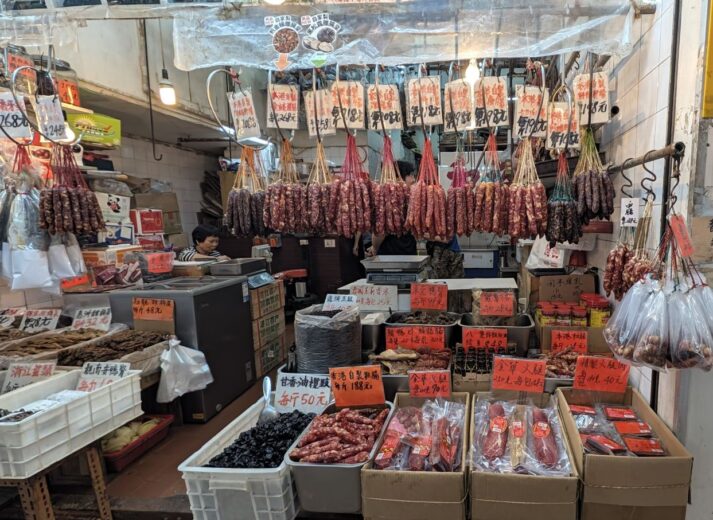
Now under the stewardship of third-generation custodian Sam Fu, a former banker who traded the financial world for the family business, Yue Wo Hop Kee is navigating a challenge familiar to many heritage food producers: how to preserve the craftsmanship and character of a traditional food while making it relevant to a generation whose tastes and lifestyles are constantly evolving.
Our visit to Yue Wo Hop Kee’s production facility offered a fascinating glimpse into just how much work goes into making something that most of us consume without giving its production a second thought.
The Art of Making Lap Cheong: Simple Ingredients, Extraordinary Patience
Sam repeatedly reminded us that lap cheong is fundamentally a simple food, made from a handful of familiar ingredients: pork, Chinese rose liquor (玫瑰露酒), pepper, salt and sugar.
There are no elaborate culinary tricks behind these ingredients. What transforms them into a fragrant, deeply flavoured sausage is the careful handling of the meat, the proportions of the seasoning and, perhaps most importantly, the curing and drying process.
At Yue Wo Hop Kee, different varieties are prepared using different meat-to-fat proportions, including entirely lean meat, 80% lean meat to 20% fat, and 70% lean meat to 30% fat. These ratios influence not only the richness of the finished sausage but also its texture, mouthfeel and how its flavours develop during cooking.
The choice of pork is equally deliberate. Yue Wo Hop Kee uses pork shoulder, a hardworking muscle with a more pronounced meaty character than leaner cuts such as pork loin. Its natural marbling contributes richness, while its robust pork flavour provides a suitable foundation for the assertive fragrance of Chinese rose liquor.
This liquor is one of the defining ingredients of traditional Cantonese lap cheong. Its distinctive floral aroma, often associated with rose-scented spirits of relatively high alcohol content, contributes an unmistakable fragrance that remains evident even after the sausages have been steamed.
During marination, salt begins drawing moisture from the meat while the seasonings are distributed throughout the mixture. Over time, salt, sugar and the aromatic compounds from the liquor contribute to the development of the sausage’s characteristic flavour and texture. The subsequent drying process reduces moisture further, concentrating the flavours and producing the familiar firm consistency.
The ingredients may be uncomplicated, but the transformation is anything but instantaneous.
Why Hands Still Matter
In an age when food manufacturing increasingly relies on automation, it would be easy to assume that making lap cheong is simply a matter of feeding seasoned meat into a machine and waiting for the finished product to emerge.
At Yue Wo Hop Kee, however, much of the production process remains manual.
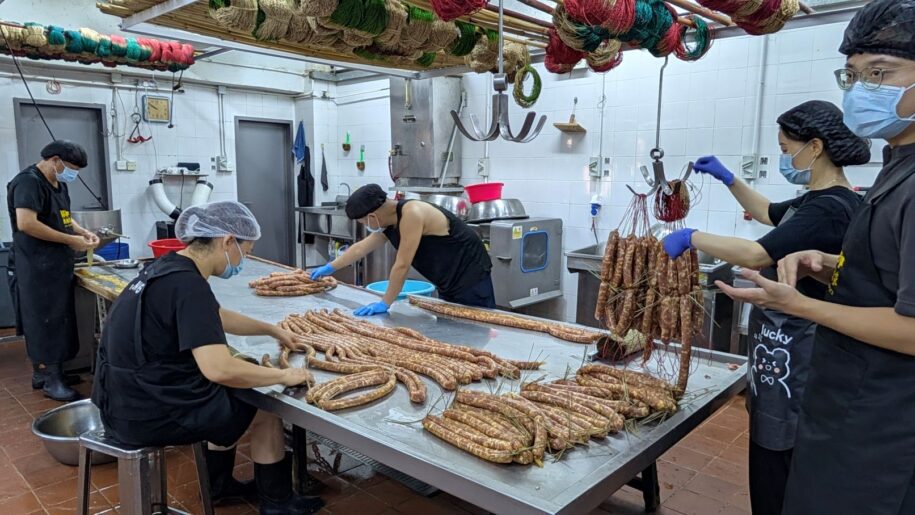
From marinating and mixing the meat to filling the natural pork intestine casings, pricking the sausages, measuring and tying individual links, human hands remain central to the process.
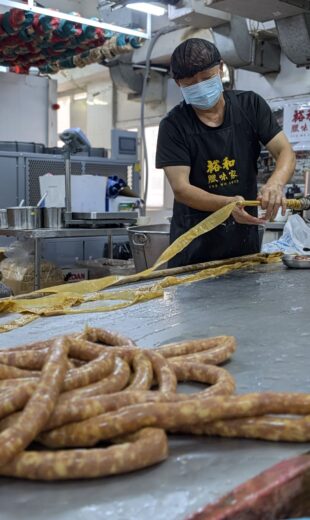
Even something as seemingly straightforward as mixing the marinated meat serves an important purpose. By handling the mixture, the maker can feel its consistency and ensure that the seasoning is distributed evenly. It is a tactile assessment that comes from familiarity with the ingredients and repeated practice.
Stuffing the sausages requires another degree of sensitivity. Natural intestine casings are delicate, and the filling must be introduced with sufficient pressure to create a properly formed sausage without overstretching or damaging the casing. Too loosely filled, and the finished sausage may lack the desired consistency; too tightly packed, and the casing risks splitting.
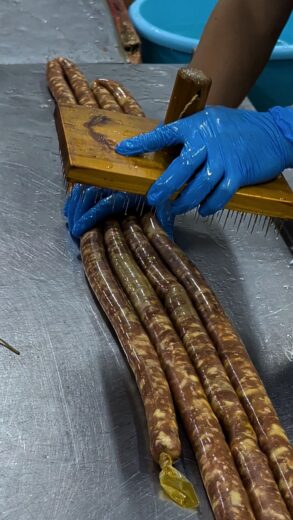
Once stuffed, the casing can stretch several metres in length and must be carefully inspected for trapped air bubbles, which can interfere with even drying and distort the finished sausages. Armed with a handheld paddle studded with fine needles, the craftsman works swiftly yet delicately along the entire length of the casing, pricking its surface to release pockets of air without damaging the fragile intestine lining. It is another seemingly simple task that demands a practised hand, balancing speed, precision and just the right amount of pressure.
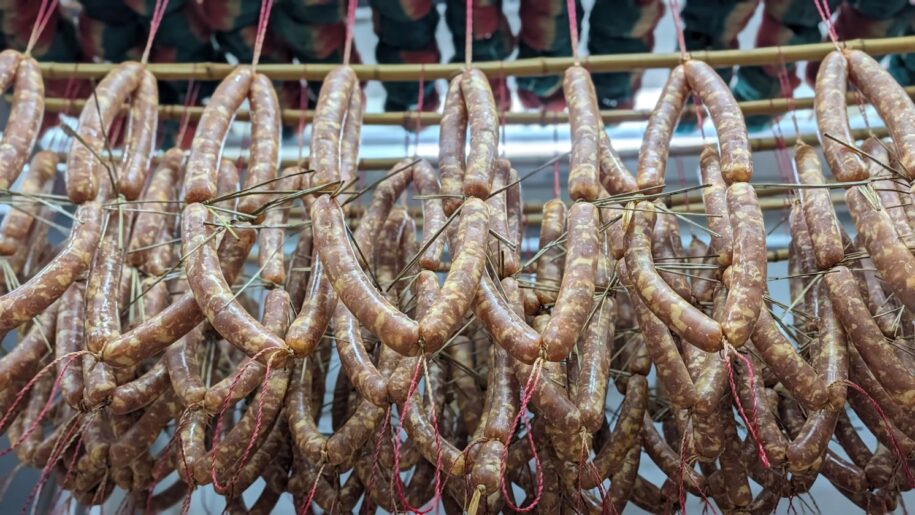
Each sausage is subsequently measured and hand-tied. Different coloured strings are used to identify the various types of lap cheong, a practical detail that also gives the rows of freshly prepared sausages a distinctive appearance.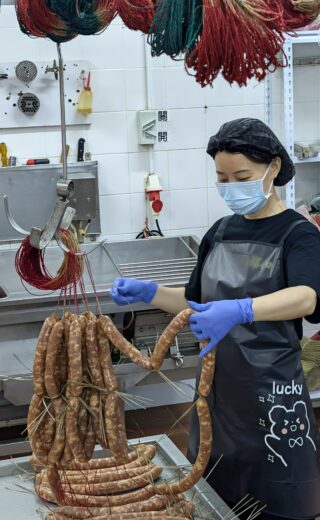
What struck us during the visit was that almost every stage of production involved someone physically handling and inspecting the sausages. This repeated human contact allows the makers to assess their work throughout the process, rather than relying solely on a final inspection or randomised inspection.
Four Days of Patience: The Art and Science of Drying
Once the sausages have been stuffed and tied, they enter one of the most important stages of production: dehydration.
Traditionally, Chinese preserved meats were hung outdoors to dry in the cool, relatively dry winter air. Their production was therefore closely tied to seasonal weather conditions, and the quality of the finished sausages depended partly on the environment.
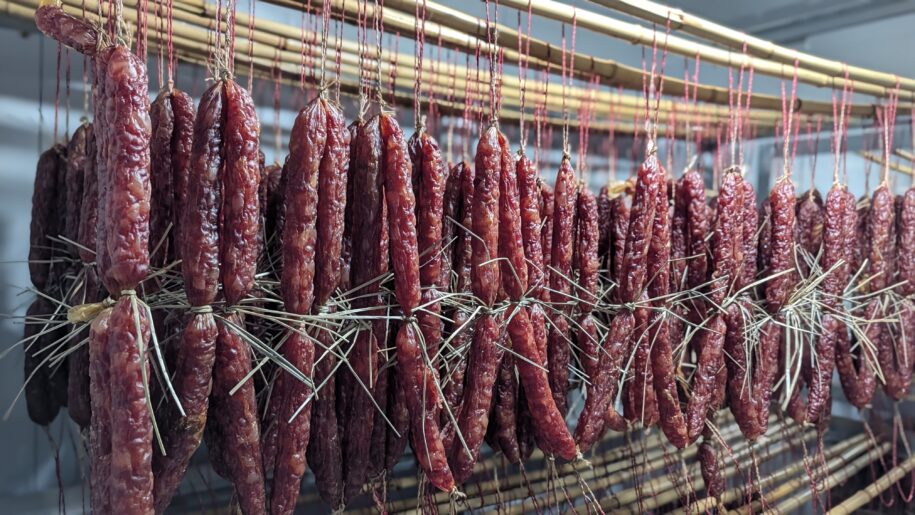
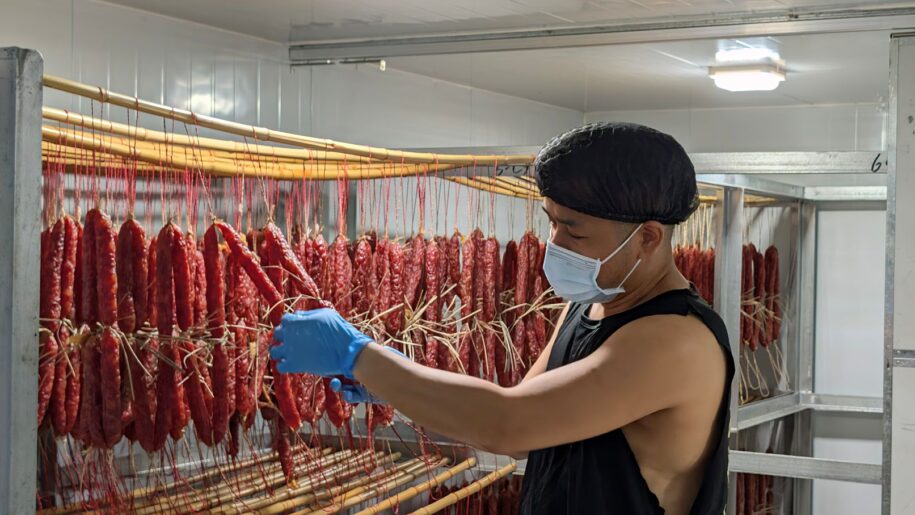
Today, Yue Wo Hop Kee uses a temperature-cum-humidity-controlled drying chamber, allowing production to continue without depending entirely on favourable weather. This modern approach also provides a more hygienic and consistent drying environment.
Despite technological advancements, craftsmanship still remains at the heart of production.
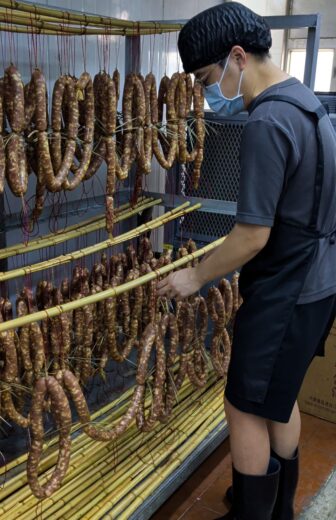
One particularly fascinating detail was the need to rotate the sausages throughout the drying process. As gravity gradually pulls the meat mixture towards the bottom of each hanging link, the sausages must be repeatedly turned to redistribute the filling, ensuring an even thickness and the familiar cigar-like shape. Now imagine stepping into a sweltering drying chamber, where waves of warm air envelop you as you work your way through rows upon rows of hanging sausages. With at least 500 links suspended at any given time, the task demands more than a thousand individual rotations, all performed by hand. Every sausage demands the same attention, and the work continues until the last link has been turned.
It is a small but revealing example of the knowledge involved in traditional food craftsmanship. A drying chamber can regulate temperature and humidity, but it still takes an experienced maker to recognise when a sausage needs attention.
Watching the rows of sausages suspended from bamboo poles, we were reminded that the beauty of artisanal food production often lies in such seemingly insignificant details. Individually, they may appear trivial. Collectively, they determine the consistency, appearance and eating quality of the finished product.
And while industrial production can certainly manufacture lap cheong in considerably larger quantities, the continued practice of these hands-on techniques is part of what makes traditional producers such as Yue Wo Hop Kee worth documenting.
Three Lap Cheongs, Three Personalities: Our Tasting
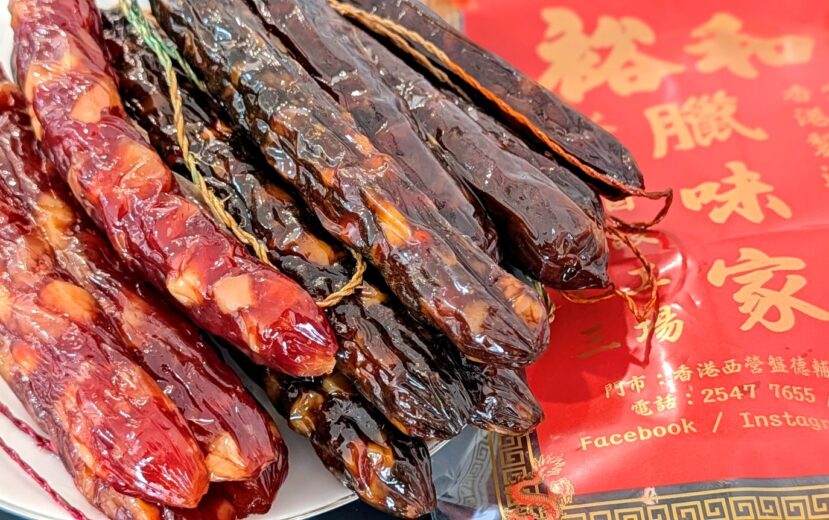
Sam generously gave us three varieties to sample: traditional meat lap cheong, meat and goose liver, and golden dried oyster.
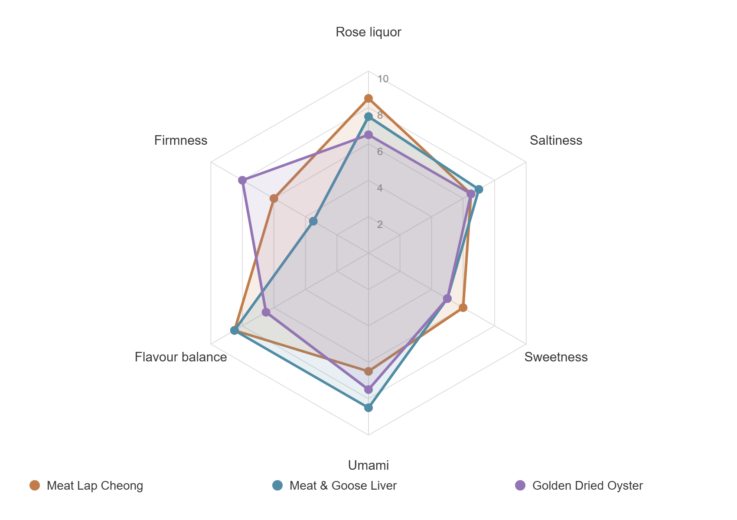
We steamed the sausages and assessed them across six sensory characteristics: rose liquor intensity, saltiness, sweetness, umami, flavour balance and texture. Our intention was not simply to declare a winner, but to understand how different ingredients influence the character of a familiar Chinese preserved sausage.
Traditional Meat Lap Cheong – The Beauty of Balance
The traditional meat lap cheong proved an excellent benchmark, with its most distinctive quality being the pronounced fragrance of rose liquor. The aromatic, floral notes arrived first, followed by a moderate saltiness that was pleasantly rounded by the sweetness of the meat and seasoning.
Made with pork shoulder and a coarser mince, the sausage had a slightly firmer, more substantial bite, consistent with its handmade character. What we particularly enjoyed was the way the flavours developed on the palate. The initial saltiness gradually gave way to a lingering aromatic sweetness from the rose liquor, leaving a satisfying finish that encouraged another slice. Its greatest strength was that we could enjoy several pieces without experiencing palate fatigue.
Meat and Goose Liver Lap Cheong – A Softer Bite, A Deeper Savouriness
Of the three varieties, the meat-and-goose-liver lap cheong emerged as our personal favourite. While its rose liquor character was slightly less pronounced than that of the traditional version, the addition of goose liver introduced a noticeably deeper savoury dimension.
Liver can be a divisive ingredient, particularly when its mineral notes become too assertive. Thankfully, that was not the case here. The goose liver contributed a gentle richness without an overwhelming metallic character, while the slightly lower sweetness allowed its savoury qualities to take centre stage. Its umami intensity left a satisfying richness that lingered pleasantly on the tongue.
The most noticeable difference was its texture. Considerably softer than the traditional lap cheong, it had a more delicate consistency and tended to crumble when sliced after steaming. This made it particularly enjoyable eaten on its own, although it might be less suitable for vigorous stir-frying, where a firmer sausage would better withstand tossing in a hot wok.
What impressed us was not simply the addition of goose liver, but how naturally it complemented the familiar character of lap cheong. The result was richer and more savoury, yet unmistakably rooted in the traditional sausage.
Golden Dried Oyster Lap Cheong – An Interesting Idea with Room for Greater Expression
The golden dried oyster lap cheong was perhaps the variety that initially piqued our curiosity the most. Dried oysters are prized in Cantonese cooking for their concentrated savouriness and distinctive marine character, so we were particularly interested in discovering how these qualities would translate into a cured sausage.
Interestingly, the oyster flavour was more restrained than we had anticipated. The addition of oyster gave a subtler umami finish compared with the liver lap cheong, but not everything has to be intense to be considered flavourful. Here, the distinctive character of the dried oyster played a supporting role in the background. The rose liquor aroma was also the mildest of the three varieties, resulting in a comparatively subdued flavour profile.
Texture presented another contrast. This was the firmest sausage of the tasting, with a more resistant bite than either the traditional meat or goose liver versions.
Some may wish for a more pronounced oyster flavour, but Yue Wo Hop Kee has deliberately taken a more restrained approach. They found that increasing the intensity of the oyster would overpower the delicate fragrance of the rose liquor, upsetting the balance between the two ingredients. After all, the intention is to create a harmonious marriage of flavours, rather than something that tastes like regular lap cheong served with a side of oysters.
A Tradition That Still Has Somewhere to Go
The future of traditional food craftsmanship does not rest solely on preserving old recipes or maintaining familiar production methods. It also depends on whether these foods continue to hold meaning for the generations that inherit them.
For Sam, that means balancing the practical realities of running a business in one of the world’s most expensive cities with the responsibility of maintaining a craft that has been part of Chinese food culture for centuries.
His willingness to experiment with new flavours and unconventional collaborations may not appeal to every traditionalist. Yet there is something encouraging about a young custodian who believes strongly enough in his family’s heritage to explore ways of keeping it relevant.
Our tasting offered a small illustration of that philosophy. The traditional meat lap cheong impressed with its aromatic rose liquor and effortless balance, while the goose liver variety demonstrated how an additional ingredient could bring greater savoury depth without overwhelming the original character. The golden dried oyster version, meanwhile, reminded us that innovation is not always guaranteed to succeed simply because an ingredient is unusual.
What matters is the thought and craftsmanship behind it.
And perhaps that is where Yue Wo Hop Kee’s story becomes particularly meaningful. Sam is not trying to convince the world that traditional lap cheong is outdated and needs to be replaced. He is simply finding new ways to remind people why it deserves to remain part of our food culture.
After all, a tradition can only remain alive if there are people willing to continue practising it, and others willing to appreciate what they make.